A Sentence Without a Full Stop: Talking with Monet
A visitor wanders Monet’s garden at Giverny in conversation with the painter, discovering gardening as an act of patience, attention, and listening rather than control.


I arrived at Giverny on a morning washed thin with mist, the sort that makes the air taste of pears and river water. The garden was already awake. It breathed and shifted like a living room after guests have slept there, creased, intimate, full of warm disorder. Claude Monet stood near the bridge, hat angled against the light, his beard catching pollen. He did not seem surprised to see me.
“You have come early,” he said, as though we had arranged it. “That is when colours are most honest. Later they begin to perform.”
I told him I had come to learn about gardening.
He smiled. “No one comes to learn gardening. They come to learn how to look.”
We walked the path together, gravel ticking underfoot like a clock dismantling itself. The borders rose on either side in unruly choirs, foxgloves like pale bells, irises with their painterly droop, roses scattering petals as though they could not be bothered to stay intact. I noticed how nothing seemed planted in rows, yet everything belonged.

“You do not impose order?” I asked.
“I coax it,” he replied. “A garden is a conversation. You speak first by choosing the ground, the water, the bones of it, and then you learn to listen. Most people only talk.”
He knelt to straighten a stem that had leaned too far into the path. His hands were stained the colour of old leaves and turpentine.
“When I first bought this land,” he said, “it was ordinary. Apple trees. A small stream sulking through it. But I wanted a place where time might slow down enough to be seen.”
“And you found it?” I asked.
He shrugged. “I made it, and then it made me back.”
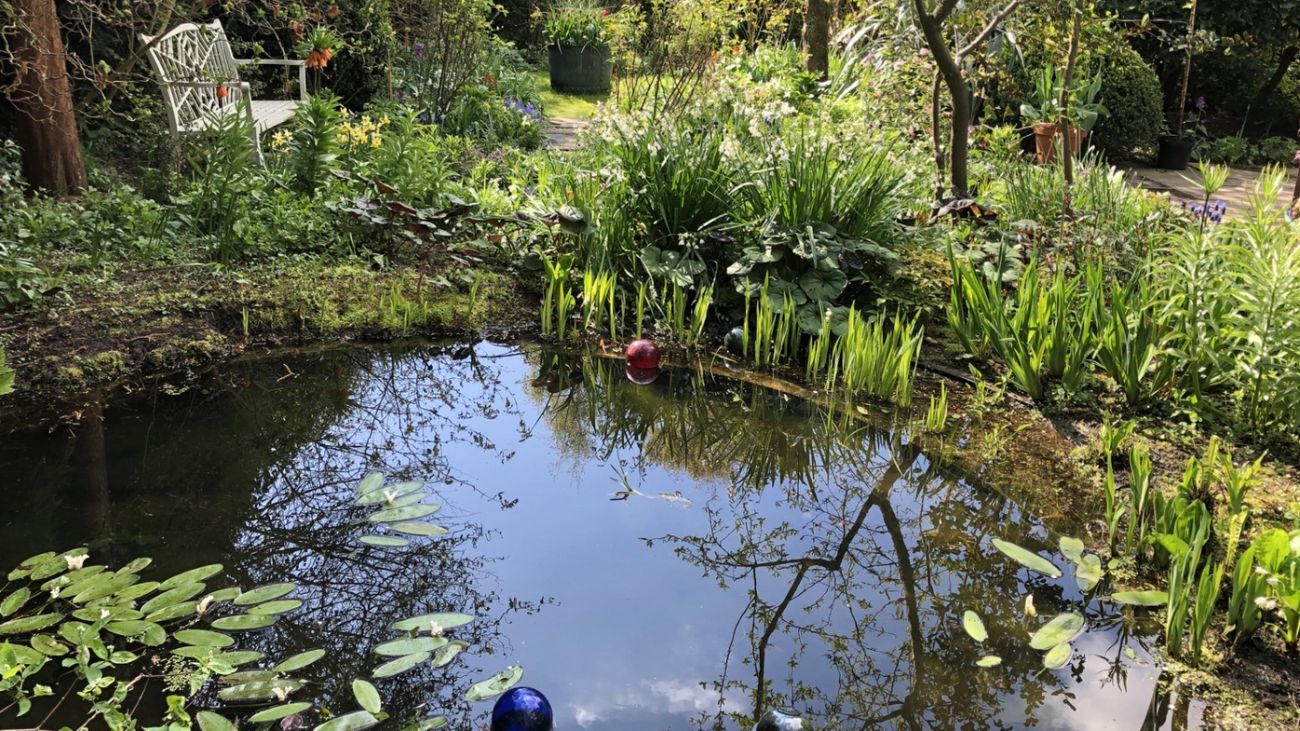
We reached the pond. The water lilies floated like thoughts that had finished travelling. The bridge arched over them, green and slight, as modest as a sentence not yet spoken. Dragonflies stitched blue lines through the air.

“I planted the pond for painting,” Monet said. “But it taught me gardening instead.”
“How so?”
“Painting is hunger. Gardening is appetite.” He laughed softly at his own phrase. “With paint, you take. With plants, you wait.”
A breeze stirred the surface of the water, breaking the reflections into pieces. The sky fractured and rearranged itself.
“You see,” he continued, “the gardener must accept repetition. The lilies bloom, fade, return. Each year the same, but never identical. That is the great lesson.”
I told him that many people garden for results, neatness, productivity, admiration.
“Ah,” he said, and tapped his stick against the bridge rail. “Those are ornaments, not reasons. A garden is not a painting to be finished. It is a sentence that refuses its full stop.”

We moved on, and the sun sharpened. Bees shouldered past us, busy and mild. Somewhere a cuckoo tried out a note and set it aside.
“I often think,” Monet said, “that people confuse control with care. They cut and tame because they are afraid of abundance. Look here.”
He gestured to a corner where nasturtiums had slipped their bounds and were marching toward the grass.
“They were not asked,” he said, “but they answered anyway.”
I bent to touch a leaf, cool and peppery. “Do you ever lose things?” I asked. “Plants that fail?”
“All the time.” His face clouded briefly, like the sun passing under a thought. “A garden is a catalogue of losses. Frost, drought, misjudgment. But each failure sharpens the eye. You begin to see what wants to live here.”
“And what wants to live at Giverny?”
He spread his arms. “Light. Water. Confusion. They are good companions.”
We sat on a bench warmed by previous suns. The air thickened with scent, sweet pea, damp earth, the medicinal tang of crushed stems.
“You must understand,” Monet said, more quietly now, “I did not make this garden to escape the world, but to hold it.”
He looked toward the house, its green shutters blinking.
“In Paris, the world rushed me. Here, it waits. Or perhaps I learned to wait with it.”
I asked him whether painting changed his gardening.
“It ruined it,” he said cheerfully. “I see colour everywhere now. The way yellow irritates blue if planted without a mediator. The way white heals an argument between reds. Gardening is composition slowed to the pace of rain.”
“And writing?” I ventured. “Is there kinship there too?”
Monet considered this. “Writing is another garden. Words are perennials if you choose well. Annuals if you do not.”
We rose and wandered again. Noon pressed down, and shadows shortened like held breaths. A gardener passed us, quiet, respectful, part of the place rather than a custodian of it.
“You employ many hands,” I said.
“Yes. A garden this size is a village. But vision must be singular. Otherwise you get compromise, and compromise makes mud.”
At the edge of the water, Monet stopped. He leaned on his stick and watched the lilies for a long time, as though waiting for one to speak.
“People think this is about beauty,” he said finally. “But beauty is the by product. What I seek is attention. Prolonged, loving attention.”
He turned to me. “If you take anything back with you, take this, garden as though someone dear were about to arrive.”
“Every day?” I asked.
“Especially the ordinary ones.”
The afternoon tilted. Light mellowed, growing edible. I felt, suddenly, the sadness that comes with belonging somewhere briefly.
“I must go,” I said.
“Yes,” Monet replied. “The garden continues best when unobserved.”
We stood, and he offered me his hand, warm, solid, real.
“Come back,” he said, already turning away. “The conversation is never finished.”
As I left Giverny, the garden folded itself behind me, unbothered by my absence. I carried with me the sense that gardening was not about mastery, nor even beauty, but about living alongside time without trying to hurry it along. And somewhere, I felt sure, Monet was still there, listening to the lilies say the same thing, differently, again.