Community Gardening: The Good, The Bad, The Beautiful
I have volunteered myself to a community garden and I reflect upon the wonders of this space, the amazing people who run it, and the difficulties of maintaining it. I also have my usual rambling rants of indignation - enjoy.


To the eagle eyed, and those sensible enough to frequent the digital pages of this publication, you will recall my volunteering for a community garden. I am pleased to inform you that I recently attended my first session. I woke up on early on the day, buzzing with excitement. Donning my trusty SR-1 secateurs like a pistol on my hip, I set off ready to get stuck in. I arrived early as I usually do; half an hour early is as late as I can be. However, in my excitement, I had arrived 45 minutes early, that's a lot of time to burn. Nonetheless, I saw a group of people congregating in the garden and headed in.
As I step through the threshold, rushing towards me is the largest dog I have ever seen. I say dog, this creature was more akin to Cerberus – the three headed dog that guards the gates of Hades, preventing entry for the living, and the dead from exiting. I felt that I may be in the latter category as I stare this beast in the eyes. I came to the realisation that I was this animal’s desired destination, my life flashed before my eyes; disappointingly quickly I might add. So, as I stand frozen, waiting to see the light, this titan flies past me with such force that I feel the ground tremble beneath my feet. It turns out I was merely a barrier between him and his beloved ball. Phew! Once all present had stopped laughing, the dog walkers were kind enough to keep me company, discussing life’s problems, and mysteries with me until the other volunteers arrived.
The good
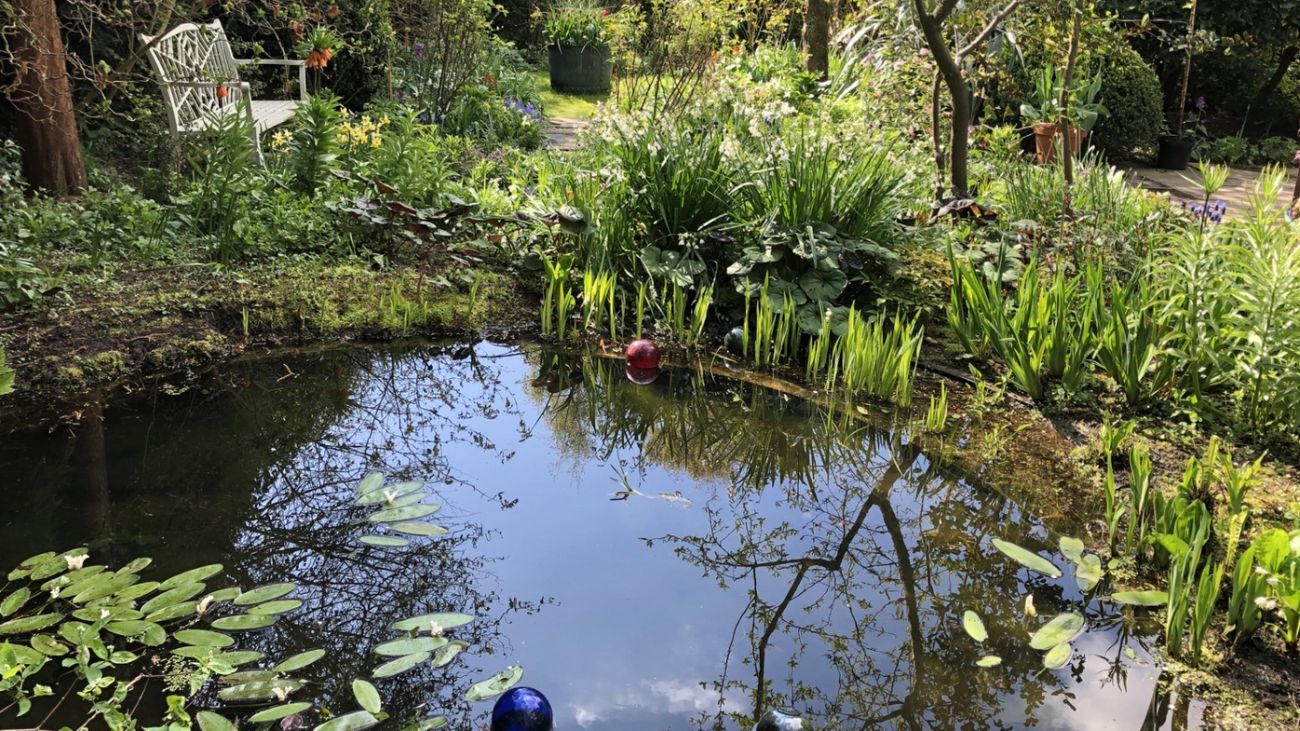
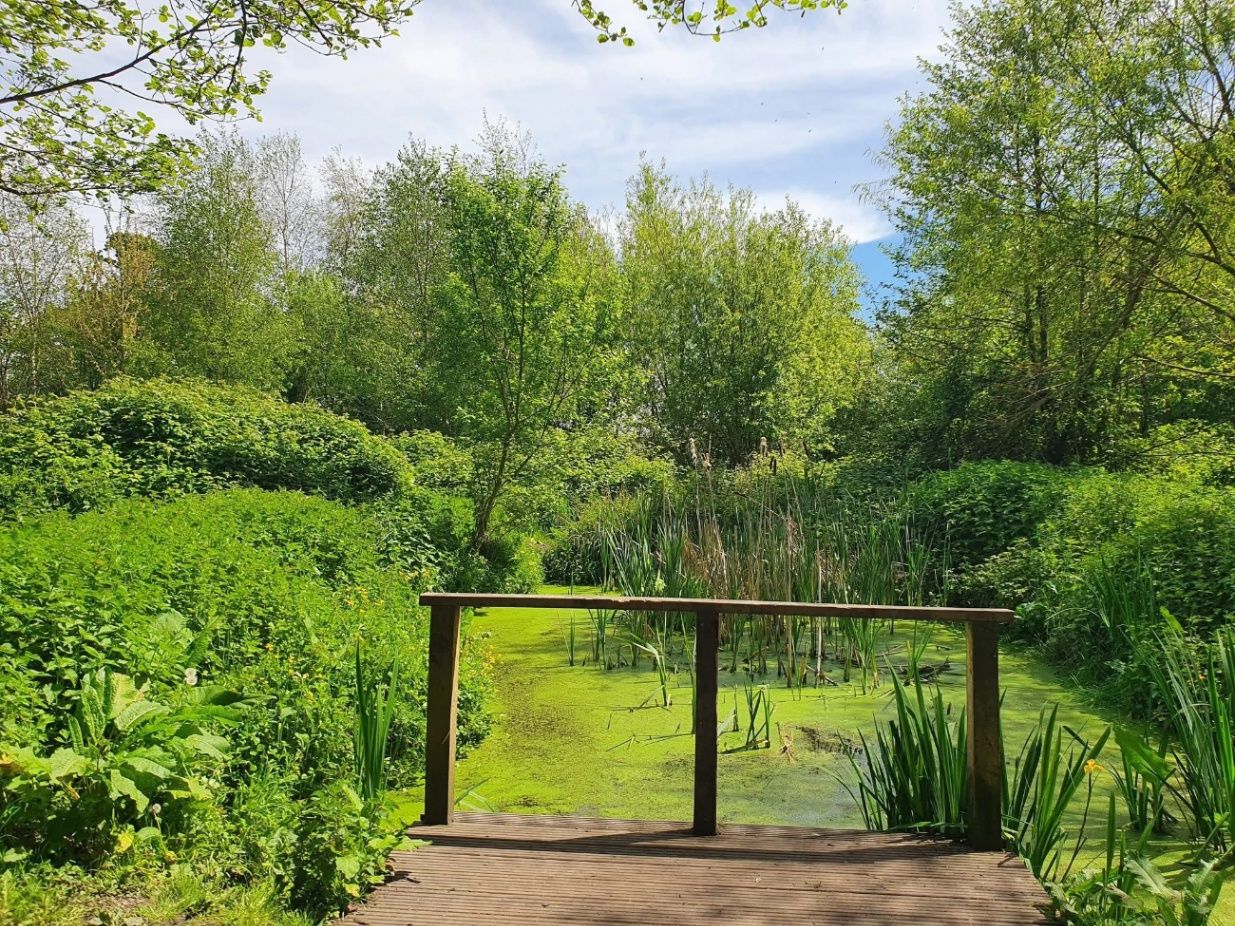
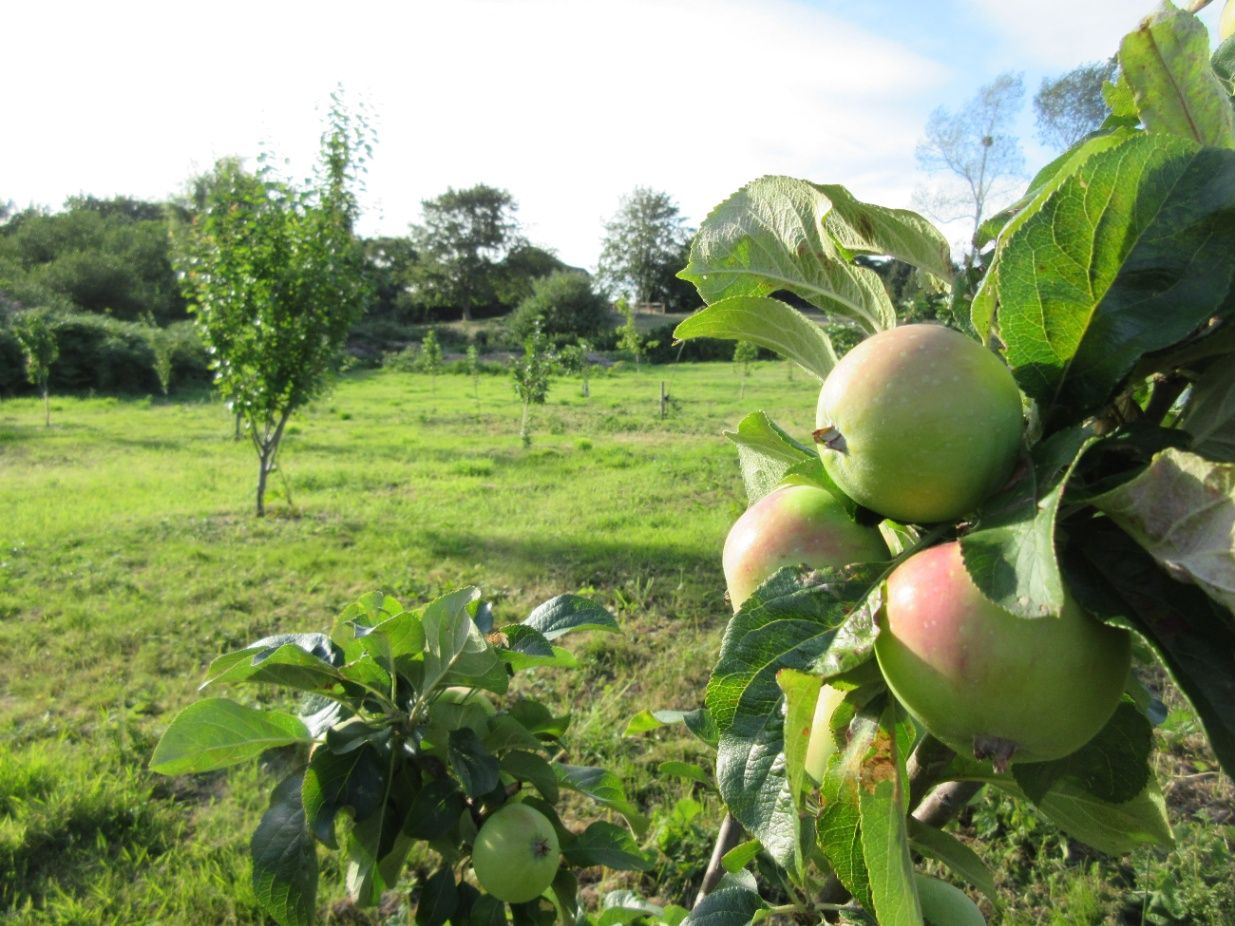
This garden is magnificent; hedgerows surround the garden like the walls of Troy, with ancient trees dotted around like sentries on duty. In the centre there is a orchard organised in a regimental fashion, a combination of apple, plumb, and pear trees. The majority of the garden is left to be wild with vast areas of trees and shrubs carpeting the landscape like a tapestry, apart from the winding and twisting paths that work their way through the vegetation like the Thames, allowing you to become immersed in the sounds of the wildlife under the dappled shade of the canopy. These paths eventually lead you to a pond with a tranquil seating area where you can sit and reflect, contemplating on life's wonders, or just look for frogs and newts as I did. I had one moment of reflection though, what was it Gussie Fink-Nottle said on how male newts propose to perspective mates: "he just stands in front of the female newt vibrating his tail and bending his body in a semi-circle" (Wodehouse,1934, p. 21). I wonder if that is true, if it is, I certainly didn't observe any such a spectacle in this pond, wrong time of year perhaps.
I was greeted by one of the leaders of this group, he was a calm and contemplating kind of chap called Tom, he was very knowledgeable and seemed to know every square inch of the garden. We were joined by more volunteers who openly welcomed me and started to discuss previous projects in the garden, things they had planted, and what they loved most about the garden. I had a great conversation about herbs with one lady and we ended up being separated like naughty school children who were disrupting the class. We aggregated around a bench whereby jobs were issued out to people based on skillsets and willingness to learn. I was impressed by the exchange of knowledge and skills from Tom to the volunteers, explaining how to sharpen secateurs, what tools to use, and how to use them.
I was quizzed on my fruit tree pruning ability, likely due to me being armed with my own secateurs and having discussed my indignation at how I spent two years training a pear tree against my fence, for it to be wiped out in the latest storm. However, I must have convinced them I knew what I was doing as they appeared to be confident enough in my pruning ability to let me loose on their orchard.
While others were still being allocated jobs, I was asked by another volunteer if I would hep them grab a rabbit hutch that had been fly-tipped, apparently with the rabbit still in. I agreed, and off we go walking up this steep hill until we stumble upon the rabbit hutch, it was more of a 1-bed luxury condo than a hutch (rabbit not included). Despite its luxurious appearance it was actually rather small, the volunteer picked up the homuncular resident’s condo and we headed back. I asked what we were going to do with the newly acquired property, the suggestion being to repurpose it for wildlife living within the garden, a smashing idea, noting better that repurposing something instead of it going into landfill.
As we navigated the slope with as much grace as the chuckle brothers, this chap said to me, “at least we got to have a nice chat, eh”. For some unknown reason, this caused the old lemon to start zesting, and the grey matter started firing neurons like arrows from Odysseus’s bow. As a social worker my mind is often triggered into how simple, overlooked things, like gardening, can improve a person’s quality of life. I guess this comes from having to work in environments that are often under-resourced, and initiative and creativity are key.
Professional curiosity
I was curious how social isolation, wellbeing and mental health could be improved by gardening. I did a bit of digging and found a study by Wood, et al. (2022). This utilised survey data from 4,919 participants aged 46-80 years and explored how time spent gardening improved their wellbeing. This showed that people who engaged in gardening for at least 150 minutes per week improved their mental wellbeing and higher life satisfaction compared to non-gardeners. Who doesn't feel instantly better when your hands are in the soil like a truffle pig, planting that over-priced perennial you have purchased after having tea and cake at an overly expensive garden centre - a rite of passage in my eyes.
The study suggests that gardening for at least 2.5 hours per week is associated with improved mental health (Wood et al, 2022). I have only been gardening a short while and began at a time in my life that was significantly stressful. The positive influence on my mood from just popping out into the garden on a lunch break to do some deadheading, or even when I am watering in the garden at 5am, it was apparent to me how much better I felt, and my days more productive. I don’t know if it is the physical activity, the visual and olfactory hit to the senses, or the connection to nature that made me feel so content and relaxed, likely all of the aforementioned.
There is very little specific data on the benefit of community gardening or the therapeutic impacts from it, I read a study by Wood, Barton, and Wicks (2022) carried out during the pandemic of the ‘Growing Together’ therapeutic gardening program in Essex. This study tracked the wellbeing, loneliness, and life satisfaction of participants. The data showed that there were significant improvements to wellbeing evidenced, although the pattern of these improvements between male and female participants were significantly different. Male wellbeing improved early in the study, and plateaued, whereas female attendants’ wellbeing fluctuated, and peaked toward the end of the study (Wood, Barton, and Wicks, 2022). I am intrigued as to what led to this difference. Gardening is such a personal reflection of one's self, and we all garden in our own ways. So were the differences highlighted down to the activities carried out at the time. For example, were people doing tasks and activities in the garden that they didn’t really enjoy, could it have been they were with people that they did not relate, or even dislike?
I note that Tom, the leader from the group, appeared more anxious toward the end of my first session than he did at the beginning. There is strong evidence to suggest that this was down to ‘yours truly’ and our differences on pruning. I am of the mindset, and have always been taught, that you should remove any crossing or rubbing branches to prevent disease and encourage new growth. Am I right, would you agree with me? It was, in Tom’s opinion, to remove the diseased branches and allow the rest of the trees to be as they are.
Tom’s method was increasing my anxiety levels, I felt like people were trying to put me in the corner, and no one puts Scotty in the corner. I wanted to be free to prune the way I wanted to prune. I felt, and still feel, that little sacrifice in pruning would lead to a better life for the trees. So, after scanning the orchard for my ‘Abbe Faria’ of fruit tree pruning, and waiting for his back to be turned. Once the coast was clear, the loppers and pruning saw were deployed and put to action. I was liberating branches from these trees like British troops from the beaches of Dunkirk (sorry, Tom). I wasn’t too brutal, I promise.
The bad
Although community gardening projects provide benefits, research by McGuire, Morris, and Pollard (2022) explored the perspectives of organisers - like poor Tom - and suggests they face many challenges. The success of these projects relies upon the kindness, skills, social capital, and resources of volunteers. This is quite a responsibility and commitment from people who do this from the goodness of their hearts, in their own valuable time. This study has helped to highlight how gardens have come to be seen as ‘therapeutic landscapes’ that can provide ‘meaningful activity, social interaction and mental restoration’. This is indeed accurate; however, it must be stressed that community gardening projects are at risk losing their ‘essence’ due the ‘medicalisation’ of these projects through over-prescribing by public health bodies. What I mean by this is, these groups should not be exploited and seen as a resource to fill gaps within public services that cannot cope with the pressures that exist. Yes, community gardening must be integrated within public health strategies, but the funding and resources that projects rely upon must be consistent, especially, as these groups are indeed picking up the slack (McGuire, Morris, and Pollard, 2022).
Like any public place, there is always anti-social behaviour and evidence of vandalism to areas within the garden. I have previously seen fly-tipping in the garden, and even went to investigate what was perceived as a body in this garden with a volunteer, before I was an active member, thankfully it was just some fly-tipped rubbish in bin bags. Although this has become a story which I relish telling people with great detail and enthusiasm, like an Arthur Conan Doyle novel, only to disappoint people with an anti-climatic ending. I have also witnessed groups of people drinking in the garden, shouting abuse at passers by which has intimidated people form using the garden. It is shame these things happens, but I see this as part of why I volunteer, to help repair and maintain this area of our community for everyone to enjoy - even if I don't agree with how they use it.

The beautiful
As I was, in the eyes of Tom, mutilating the branches of these fruit trees, I was introduced to another, rather young looking, volunteer who opened our conversation with, “I may look 14, but I am actually 32”, a justified opening considering my judgment of their youth. We were both allocated to pruning duty and began with the usual conversational topics of talking about the weather, and where we grew up. Whilst hacking away care-free at the branches, all the time Tom is wincing, looking like he is in physical pain and politely guiding us to the ‘right way’ of doing it, we fall upon the topic of the environment. We mainly discussed the local environment, it turns out that my 'ageless' companion is a trainee environmental lawyer, and more importantly, the founder of a community group who carry out planting projects in small suburban spaces. I am informed they plant trees or wildflowers in cul-de-sacs, and in those hideous traffic claiming planters you see on backstreets, you know the kind, big brick monstrosities that jolt out into the road like a deer on a country lane. Despite their unappealing aesthetics, they were put in to serve a purpose, mainly to stop the Renault 5s and Citroen Saxo's with Carlos Fandango wheels from being a menace to society, whilst listening to Helter Skelter. I just wish more people would take the initiative, care, and interest in where they live.
I cannot stand to see public spaces looking neglected, or even just filled with bare soil, it is such a waste. I have now volunteered myself to become involved with this group and hope to get stuck in soon. it just goes to show that you cannot underestimate the power of a good chinwag, whilst being out in the fresh air gardening. It does so much for you as an individual, but also for others in your community, and positively impacts environment. Having met all these wonderful people who are spending their time to make a difference in their communities, fighting for causes close to their hearts, and improving the lives of others has really restored my faith in humanity.
If you already run a community garden or want to access funding to create a community group, I have added a list of resources to help, which includes how to find out who your local councillor or MP is. This is particularity useful as they have the knowledge of the community and how to also access funding on a local level. Oh! And as I come to a close, I just want to reassure you all that Tom and I do like each other, despite our pruning preferences. If it wasn't for people like Tom who are giving up hours, days, weeks, and even years in volunteering, these places wouldn't be here for us all to enjoy.
Resources
- https://www.grantfinder.co.uk/funding-highlights/funds/community-development/
- Find your local councillors - GOV.UK
- Find your MP - MPs and Lords - UK Parliament
Reference list
Fjaestad, S. L., Mackelprang, J. L., Sugiyama, T., Chandrabose, M., Owen, N., Turrell, G., & Kingsley, J. (2023). Associations of time spent gardening with mental wellbeing and life satisfaction in mid-to-late adulthood. Journal of Environmental Psychology, 87, 101993-. https://doi.org/10.1016/j.jenvp.2023.101993
McGuire, L., Morris, S. L., & Pollard, T. M. (2022). Community gardening and wellbeing: The understandings of organisers and their implications for gardening for health. Health & Place, 75, 102773–102773. https://doi.org/10.1016/j.healthplace.2022.102773
Wodehouse, P G (2008) [1934]. Right Ho, Jeeves (Reprinted ed.). London: Arrow Books.
Wood, C. J., Barton, J. L., & Wicks, C. L. (2022). The Impact of Therapeutic Community Gardening on the Wellbeing, Loneliness, and Life Satisfaction of Individuals with Mental Illness. International Journal of Environmental Research and Public Health, 19(20), 13166-. https://doi.org/10.3390/ijerph192013166