Discover the Sublime Beauty of Mount St John
Mount St John, North Yorkshire – a cloud-flecked day in May finds a garden on the cusp, balanced between wildness and design, memory and invention.


Among the quiet harmonies of Mount St John
The road climbs gently out of Felixkirk, hedgerows laced with cow parsley, until the land opens into high pasture, sheep-thick and wind-brushed. Up here, the air seems to hold more space between its molecules. And then, with little ceremony, Mount St John appears: a fine Georgian house with a watchful gaze over the Vale of Mowbray, and behind it, almost tucked away, one of the most quietly radical gardens in Britain.
There’s no grand drive, no fanfare. Instead, a modest gravel path draws you into a landscape that seems to breathe with the rhythms of the hills around it. Designed by Tom Stuart-Smith in the early 2000s, the gardens here are not the sort that flaunt their geometry or scream their pedigree. They are softer, looser, and more humane—a kind of gardening that feels closer to conversation than statement.
I arrive just as the wind drops. A chiffchaff sings from the ash trees above the house. At first glance, the west-facing terrace is formal—symmetrical beds, bold yew cones standing like sentinels—but then the planting begins to whisper. Soft billows of Stipa gigantea shimmer against the clipped hedging. Euphorbia glows like low embers. Astrantia and Salvia pirouette between drifts of Allium, the palette subtle but richly layered. The bones are classical, but the flesh is meadow-light.
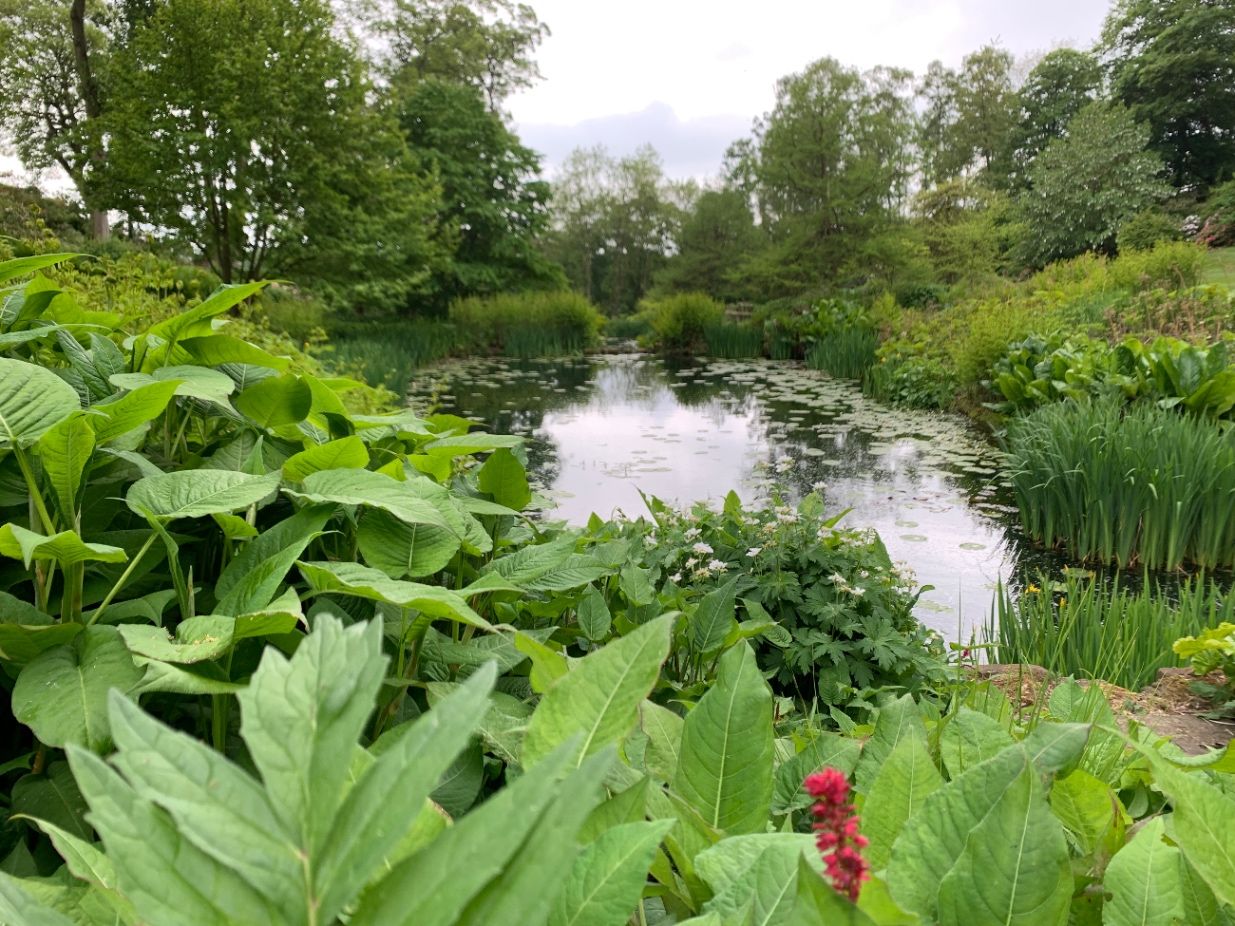
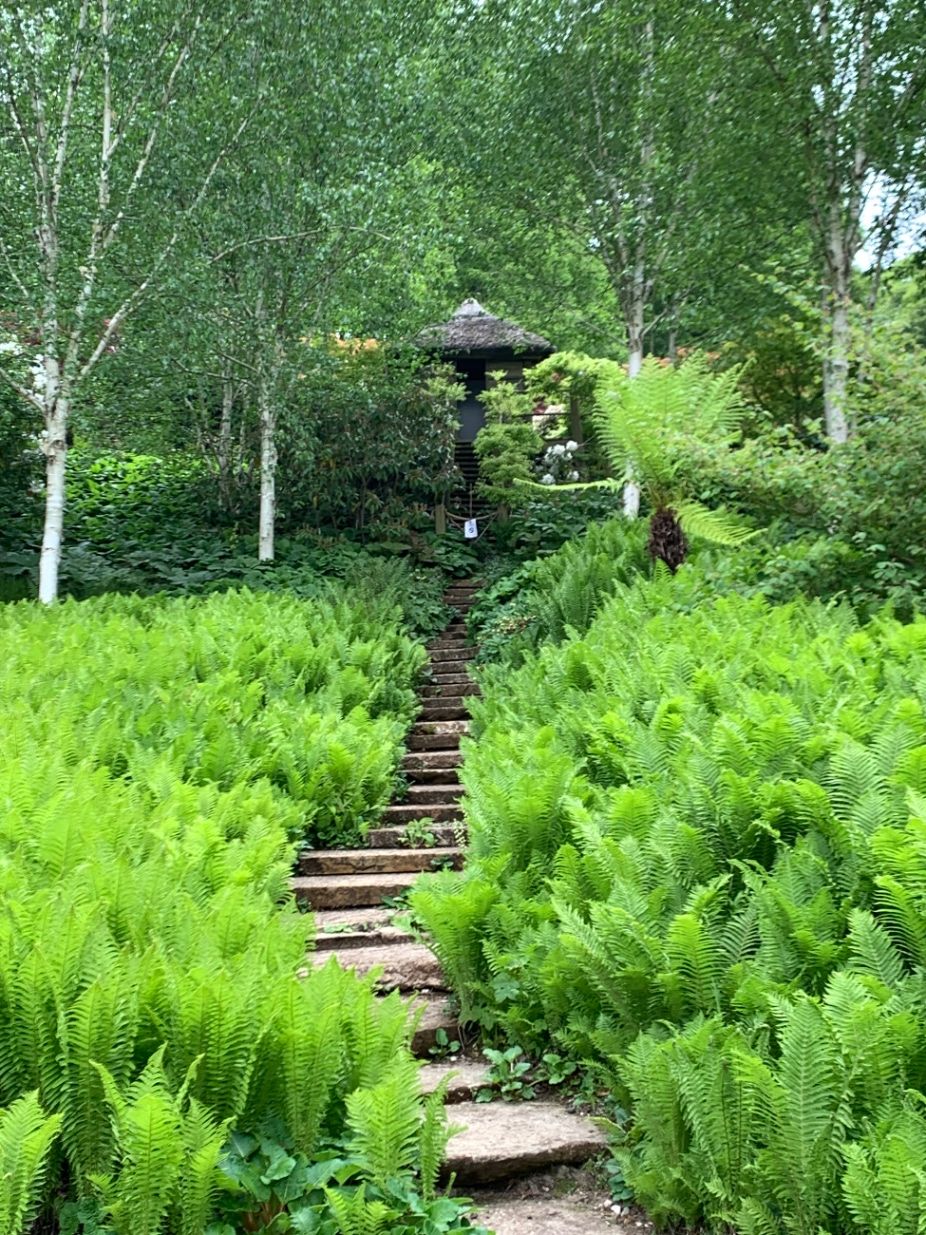
This is the hallmark of Stuart-Smith’s approach: “controlled wildness,” as he’s called it, or “nature framed.” The result is a garden that doesn’t impose itself on the landscape but listens to it, folds itself into its moods. You feel that most keenly in the Valley Garden below the terraces, where the structure dissolves entirely into a dreamy woodland stream of ferns, Rodgersia, Iris sibirica and Ligularia, all cooled by flowing water. I follow the sound of a rill, then lose it again beneath birdsong and bees.
These lower gardens weren’t part of the original brief. They came later, as the Blundell family—owners and stewards of Mount St John—sought to extend the garden’s conversation into the wetter ground below. What emerged is less a designed space than a reverie: borders give way to glades, which in turn become wet meadows and orchard edges, all animated by a quiet energy. Everything is in motion, but nothing clamours.
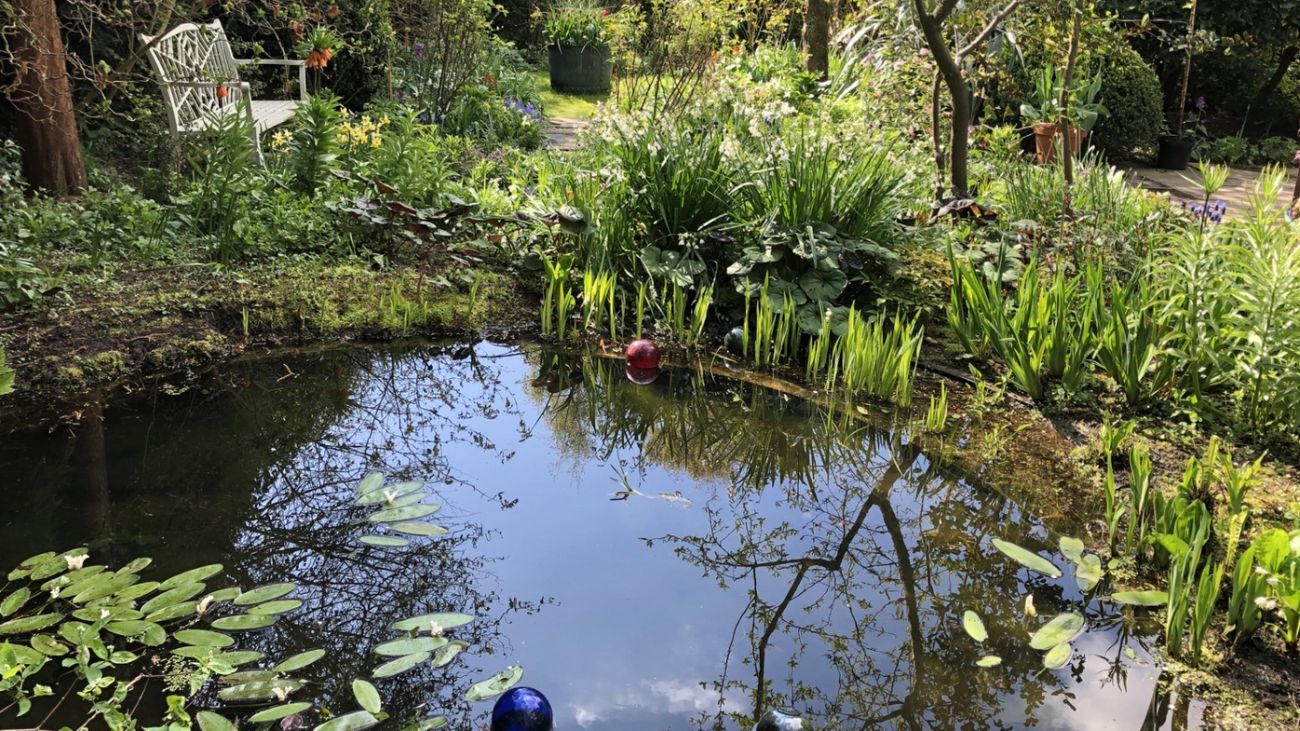
A robin flits across my path, low and certain. Under the dappled canopy, time seems to slow. Even the light behaves differently here, glancing silver off the surface of a sunken pool, then filtering through the new leaves like a benediction. Above me, a grey wagtail dances along a trickling stone. I stay still long enough to be mistaken for furniture.
Further along, the gardens open again, this time into the great Victorian kitchen garden—four acres enclosed within handsome brick walls. Here, straight lines return, but softened by abundance: rows of rhubarb bursting into flower, espaliered apple trees in blossom, the greenhouses quietly steaming with life. This is a working garden, supplying fruit and vegetables not just to the house but to local restaurants, bridging the ornamental and the edible in a way that feels both traditional and modern.
Beyond the walls, fields slope gently away toward the ruins of a medieval Knights Hospitaller preceptory—buried now, but still subtly legible in the land. In dry summers, the outlines emerge in parched tracery, and even now, the place hums with something older than gardening. Perhaps that’s why Mount St John never feels fashionable, despite its designer’s global acclaim. It’s too deeply rooted. It respects the long memory of place.
Back near the house, I sit for a while on a low stone wall that catches the sun. The scent of rosemary wafts past. Swallows cartwheel above the lawn. There is a balance here, a kind of practiced humility that allows room for imperfection, for improvisation. Plants are not forced into obedience. They mingle, self-seed, lean into each other. But nor is this a free-for-all. The scaffolding is always there—subtle but firm—like the invisible logic of a poem.
Tom Stuart-Smith has spoken of the garden as a space “between order and chaos,” and here, that idea becomes vivid. This is not a garden to be consumed in one viewing, nor one that gives up its secrets quickly. It asks you to return, in other seasons, other lights. And it rewards attention. Tiny details—a moth resting on a fennel stem, the way the breeze lifts a stand of Calamagrostis—gather meaning the longer you look.
As the afternoon draws on, the shadows lengthen across the upper lawns, and a hush begins to settle. Somewhere, a mower starts up, but even that seems gentle. I pass through one last garden room—a knot of box hedging enclosing a gravel garden studded with drought-tolerant perennials—before making my way back toward the house.
There’s no signage here, no plaques or labels. The garden doesn’t explain itself. Instead, it invites you to feel your way through. And in doing so, you begin to notice more: the relationship between slope and sightline, between breeze and border, between history and renewal. You realise the design is not just spatial but temporal—it plays out across days and decades, seasons and soil.
As I leave, I glance back. The garden doesn’t try to hold you. It continues without you, in its own slow rhythm. But it stays with you, like a well-phrased line or a remembered tune. In a world increasingly dominated by speed and spectacle, Mount St John offers something else: a kind of quiet, persistent grace.