Following Your Nose - Scent in the Winter Garden
From lipstick to chocolate, there is plenty of perfume for the January garden indoors and out


As I write, Aaron is on the flat roof pruning the white wisteria. While he is up there I have asked him to lob down a few sprigs of winter-flowering buddleja, B. auriculata (pictured above). There are still a few panicles of cream flowers left on it, and there’s no point them dangling 20 ft up the house wall. In the kitchen we can all enjoy their lemon-zest perfume.
Anosmia in Andalucia
January is a great month for scents, and this year they are smelling better than ever. Back in March 2024 I lost my sense of smell. It was at the end of a botanising week in Andalucia, where I imagined I would be basking in early spring warmth and sunshine. But the rain in Spain does not, it turns out, fall mainly on the plain. In the sierras it comes down in stair-rods - interspersed with sleet, hail and snow.
I wasn’t much surprised when by the fifth day I went down with a cold. But it wasn’t that, it was Covid – my first ever dose. I couldn’t taste or smell a thing, and even three weeks later, at a tea party to celebrate the 90th birthday of my sister-in-law’s mother, it was only by texture that I could distinguish smoked salmon from a chocolate éclair.
It took months to notice any real recovery. I stood in front of viburnum, azalea, rose, philadelphus and lilac, straining every olfactory receptor, remembering each scent but not finding it. It was torture. Happily, by the end of the summer, I was starting to catch scent in the air again, and by the end of the year, I had full reception back. Phew!
Scent puts the enjoyment of a garden into another orbit, catching you off-guard and transporting you through time and space. For me it’s the best reason to grow a plant, and if my garden has any underlying theme, scent it must surely be.
Indoor Immersion
For maximum January indulgence, I have a couple of recommendations. On one or two of the worst weather days, float yourself off to warmer climes by visiting a glasshouse. I got into this habit at university, where my room’s single bar electric heater made scant impact on the cold and damp. So I would wander to the botanic garden to sit by the tropical water lily tank or under a palm tree, and here to drink in the scents of jasmines and acacias and push my nose into an orchid. And each winter, when I am feeling sensorily deprived, I still head off somewhere for an immersion, and to hunt out perfumes I could never meet at home.
Another January tonic is to bring scent into the house, where you will after all be spending much of the month. This might be a few cut stems of buddleja in a vase; it might be a permanent resident like a pot jasmine; or it might be some forced hyacinths or ‘Paperwhite’ narcissi (though these are not my cup of tea – the scent reminds me of Chester Zoo’s elephant house). And pot up some snowdrops and crocus - if you haven’t done so in the autumn, you can dig some up now: their honey scents, wasted on us at ground level, become deliciously accessible on a table.
Scents in the Shrubbery
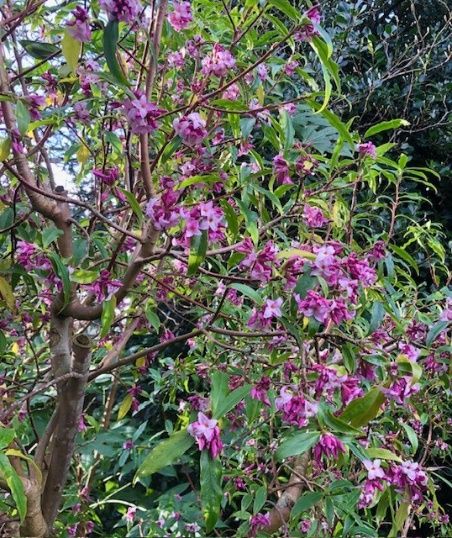
Outdoors, Mahonia japonica is delivering lily of the valley scent from its long arching racemes, Viburnum x bodnantense honey and almonds, and wintersweet a sophisticated blend of lemon and lipstick. Daphne bholua is even more spicily refined: the ‘Darjeeling’ form is the first to flower here, and ‘Jacqueline Postill’ is my biggest suckering stand, but there is now quite a range of pink and white varieties to choose among. I rate this as the best garden shrub to have come into circulation in my gardening lifetime – every garden needs one.
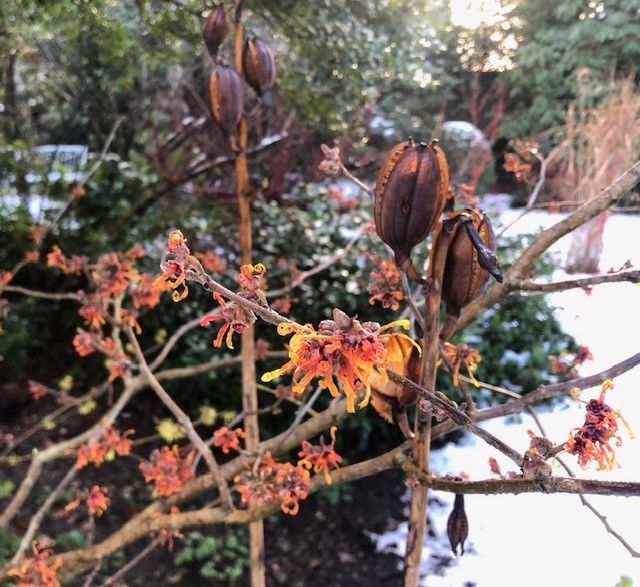
Witch hazels smell of parrots – an odour of fermenting fruit – which I find doubly pleasant since I love parrots too. They are among the showiest and most reliable shrubs for January colour, and it’s worth planting a group of them if you have got the space, though they aren’t the fastest growers. The tints of sherbet yellow, old gold, copper and maroon merge beautifully together, and look well emerging from a carpet of snowdrops and hellebores.

Perfumed partition
Aaron and I have just been ripping mountains of unstable arborescent ivy and rambler rose from the top of the 5ft wall dividing the garden from next door’s, and we have an opportunity to do a little more scented planting while we are at it. My very elderly neighbour, Leta Jones, a knowledgeable gardener herself and a good friend, always took a keen interest in what was happening here and didn’t like things getting too high. “You promised me I would be dead before that tree got to 20 ft,” she would exclaim. “Yes,” I would reply. “But I didn’t know how strong you were.” She lived to be 103.
The new neighbours – who definitely aren’t gardeners, let’s leave it at that - seem quite relaxed about the destruction. Apart from the roses, this narrow border is planted as a scheme of evergreen foliage of contrasting leaf shape and texture. And with the ivy gone, we are going to do some repeated groupings of honey-scented sarcococca among the pheasant’s tail grass and strap-leaved libertias.
Even more excitingly, there looks to be space for a second Azara microphylla on the other side of the evergreen magnolia. In spring, this tall slender shrub produces a haze of yellow flowers hidden beneath its skeletal fans of tiny leaves. Walk past it at that time and you are engulfed in the most mouth-watering scent – of drinking chocolate. Next year there will be a second cupful.