Next Year's Pies & Crumbles
Let's be honest, it has been a mixed bag in the veg garden this year, but onto the next and where can I make any small interventions, and maybe just help the garden a little more!


So it's Sunday tea time, the weather has turned but the fire is blazing and David Gilmour's new album is adding to the atmosphere, vinyl of course! I’m loving the songs with his daughter, Romany Gilmour. On top of all that, I’m sat enjoying a rather large bowl of homemade blackberry and apple crumble with a small mountain range of clotted cream on top! A bowl full of comfort and memories! I also have the company of Ash the cat so what's not to love!

From my Sunday chair, I have a great view of the front garden! Winter stems are peppered with seeds and covered in cobwebs, all sitting above a carpet of Autumn leaves, a fine display for any passing birds. I really do love this time of year as a gardener, you have a little time to just breathe and of course take stock of what has done well and as ever with the garden not so, plus of course dream of what's to come! I think gardeners are dreamers by nature, always looking, thinking and of course playing. For me, it's ‘can I help the garden a little more?’
Anyway that crumble is now sitting a little heavy, but it has led me to think about next year's harvest! My front garden is set up as an ornamental kitchen garden. Which in reality means everything is interplanted and like my approach to the ornamental garden, the planting is built in layers, just that all the planting is either edible or can be cut for the house. I tend to place trees then the shrubs, cut flowers, herbs, veg and lastly bulbs for spring cutting.
So to give you an idea, the space is about 35 metres by 12 metres. I already have worked in greengages, pears, apples, mulberries, damsons, plums, and even peaches on a south-facing wall. It may sound a lot but in reality I have made the most of the verticals in the garden, i.e. the fences and house which is south-facing so does provide a great opportunity to use the warmth that the wall soaks up. As well as that, I have some lovely old pears from a Dutch orchard which over the years they have been pruned to form pyramids and look picture rising from the mini meadow. (I had used them at Chelsea 2013 and kept them containerised, as you do!).
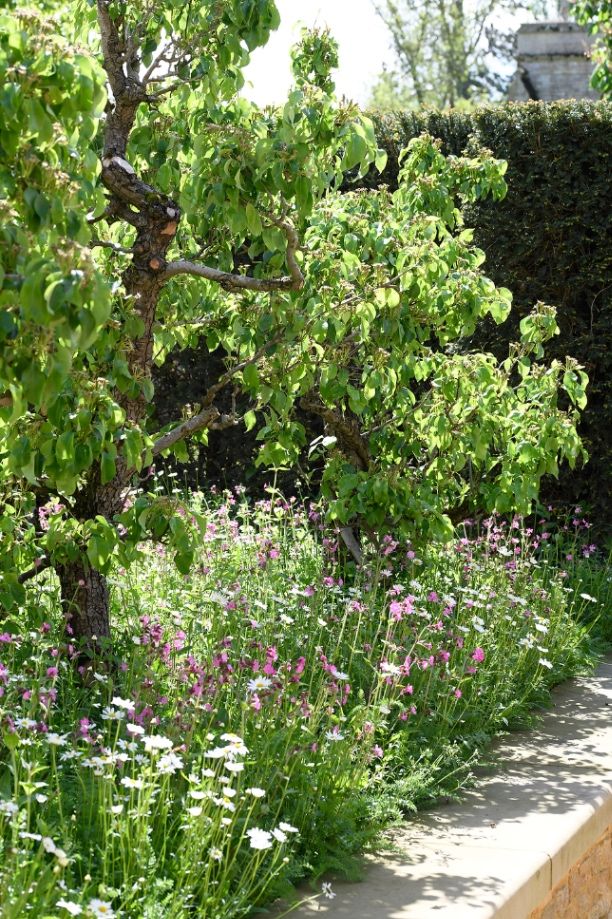
I also have a couple of goblets, which do look like wine glasses! I bought them a few years ago, they bring something just a little different to the other trained fruit. It is amazing what you can find if you just take a little time. The walls and fences carry a mix of fans, cordons, espaliers and lastly, as ends to the larger rectangular beds, I have used step-overs. I do love the craft of pruning and the history of trained fruit trees, there is something very calming about picking up your secateurs and spending a few hours more or less tailoring your trees, I think there is a certain rhythm once you get going! I even love the sound of my secateurs.

Everyone loves a little story!
Through the main season, I’m always making notes or even placing canes in borders to mark spots where I might add a little more structure or even take it away and I do tend to tinker with planting schemes each year. One thing that has become clear in the front garden during this summer is I can add a little more height in a couple of places which will also break up the space a little more. But as I have said, I’m already carrying good numbers of fruit trees, so adding to that just needs to be more than another feed or two! I want to bring something else to the conversation and there starts the story!
Our previous house had a small orchard which I was informed had a couple of local trees, and to be honest, at the time I did not know a great deal about our rich, local history when it came to apple trees and as you can imagine, it soon sucked me in.
During my time living in the house, I added a few more fruit trees to the orchard, two of them being local. The first was a ‘Barnack Beauty’ which was introduced by Brown’s Nurseries of Stamford in about 1870. It’s a sweet-tasting apple that has real depth to it plus it does seem a healthy tree. The second is a ‘Lord Burghley’ which is a great little keeper and by all accounts was found growing as a seedling at Burghley House, which is just down the road from where I live! It is said to have first fruited in 1834. I love that connection to the past and the gardeners who came before us but also the craft of breeding and how our connection with food has evolved. I think at times we take for granted the amazing choice we have. So much so that when I moved out, I thought the people moving in would not miss a couple of trees. So I dug up the four mentioned, containerised them and brought them with me (I know it’s not the best but they are special trees).
That idea of adding more local fruit is something that appeals. So from the comfort of my armchair, like a lot of us do when looking for new purchases nowadays, Google was the first port of call and within 20 odd mins I had come across a Mr Thomas Laxton, plus managed to avoid buying anything else! Anyway, 3 hours later I’m telling everyone in the house ‘do you realise that a famous plant breeder was born in the house next door’, nobody seemed to get quite as excited as me!! But don’t you worry I was not deterred!
So what of Mr Laxton? Well, he was an interesting character, Thomas Laxton, born in 1830 and as for a life lived the word colourful comes to mind. After schooling in Stamford he travelled to London to train in law and from what I can make out this is where he claims to have fallen in love with horticulture, that said if you research this man enough it will soon become clear that he liked a story!!
After his training he moved back to Stamford, where he set up practice as a solicitor. For me, this really does seem the time when Thomas really started to become fascinated with plant breeding, firstly as a hobby. He followed his father and became heavily involved in Stamford Horticultural Society where his breeding first picked up awards. The first for a new vegetable, called the 'American Custard Squash' which looked very much like a small pumpkin. His fascination for the subject must have been near obsessive as his breeding of fruit, vegetables and roses ended up with him becoming credited with over 60 varieties of plants, 3 of which were apples: Laxton’s Superb, Laxton’s Fortune and the Stamford Pippin’.
He was also a member of the Linnean and of the Royal Horticultural Society and sat on the RHS’s Fruit Committee. His work even caught the eye of Darwin who talks of Thomas in his own work and they even shared seeds!
Mind you, it was not just his breeding that had me hooked for hours but also the man personally. Thomas was married three times and his personal life was touched with huge sadness with his first wife. Annie died giving birth to daughter Annie Ashby Laxton in October 1858, leaving Thomas at 28 with a one-year-old and a new born. Two years later, Thomas remarried Jane Goodliff and went on to have 6 more children but sadly, Jane passed away at 55 and you do get the sense that Thomas’ troubles had taken their toll on her.
One thing that does not seem widely reported is that fourteen months later, Harriett Elizabeth-Ferguson, who was nearly twenty years younger became his third wife.
Thomas’ business dealings seemed a little complex which I think played its part in him ending up getting locked up for defrauding a local businessman and he was sentenced to nine months hard labour and struck off the legal roll which meant he lost his practice. Interestingly, after his time behind bars he moved to Bedford and seemed to reinvent himself, setting up a nursery which he was later joined by his sons William and then Edward. They would go on to run until 1957 when it was wound up but not before earning their place in horticultural history.
He seemed to have a lot of fingers in a lot of pies and was maybe a tad extravagant, which may have played its part in his undoing. I would have loved to have had a pint with this man in one of Stamford’s many watering holes, the more I read I was left thinking this love of creation was just not about money, it was for something else and maybe over that pint he would indulge me. He seemed to have so many friends and colleagues he worked with but just seemed at his happiest when alone with his plants. Something I think a lot of us will resonate with. So you can imagine four hours after reading about this man, the next four hours were spent trying to find myself a Laxton Superb and Laxton’s Fortune.
To a lot of people that may well seem like a long way to go about finding a couple of apple trees but for me that connection is wonderful, every time I look at that tree it will invoke a smile and I think Thomas would have loved the idea of me planting two trees he bred next door to his place of birth. On top of all that, it’s a wonderful little reminder that every plant has a story plus we have an amazing history of plant breeding and just the pure craft of gardening here in the UK. For me, its that detail of understanding that I find fascinating its like building relationships, it takes time but really can feed the soul.