On why I stopped writing: when a virtue becomes a vice
As Book Month at the Garden Collective picks up pace, Grace Alexander reflects on how writing can deepen the connection between us and our gardens, and what happens when it stops being fun.
In the most stifling month of the summer, a teenage nephew lolled on the grass and bemoaned the mandatory nature of English exams. With all the assuredness of mid-adolescence, he declared that he just simply didn't see the point.
Dear reader, I may have gasped. Words are the point. There is simply nothing of any importance that exists without words.
Although I wear a lot of hats and spin a lot of plates, the one thing that runs like a seam of gold through everything is writing. It was through writing that I made sense of my invented identity as a flower farmer and a florist. When I started my business in 2013, I also started to write. It was a very different sort of writing from my day job (anything from the simplest of how-to guides for new parents to court reports), and it was through words that I started to connect to my garden.
A huge part of that was a diary that I wrote every Sunday night for ten years. I had been rather clumsily trying to find the place where flower farming and words met when I found a very old copy of Country Living. Like all the best writers, I am prone to procrastination and displacement activity. Only the prospect of a project and a deadline drive me to housework.
An article about William Cresswell's account of being a gardener at Audley End, which I now recognise as a marketing piece, gave me an idea that felt so fittingly right that I tingled. I sat cross-legged on my studio floor, oblivious to the discomfort, and fell into a whole new genre. I was not going to be a writer; I was a diarist.
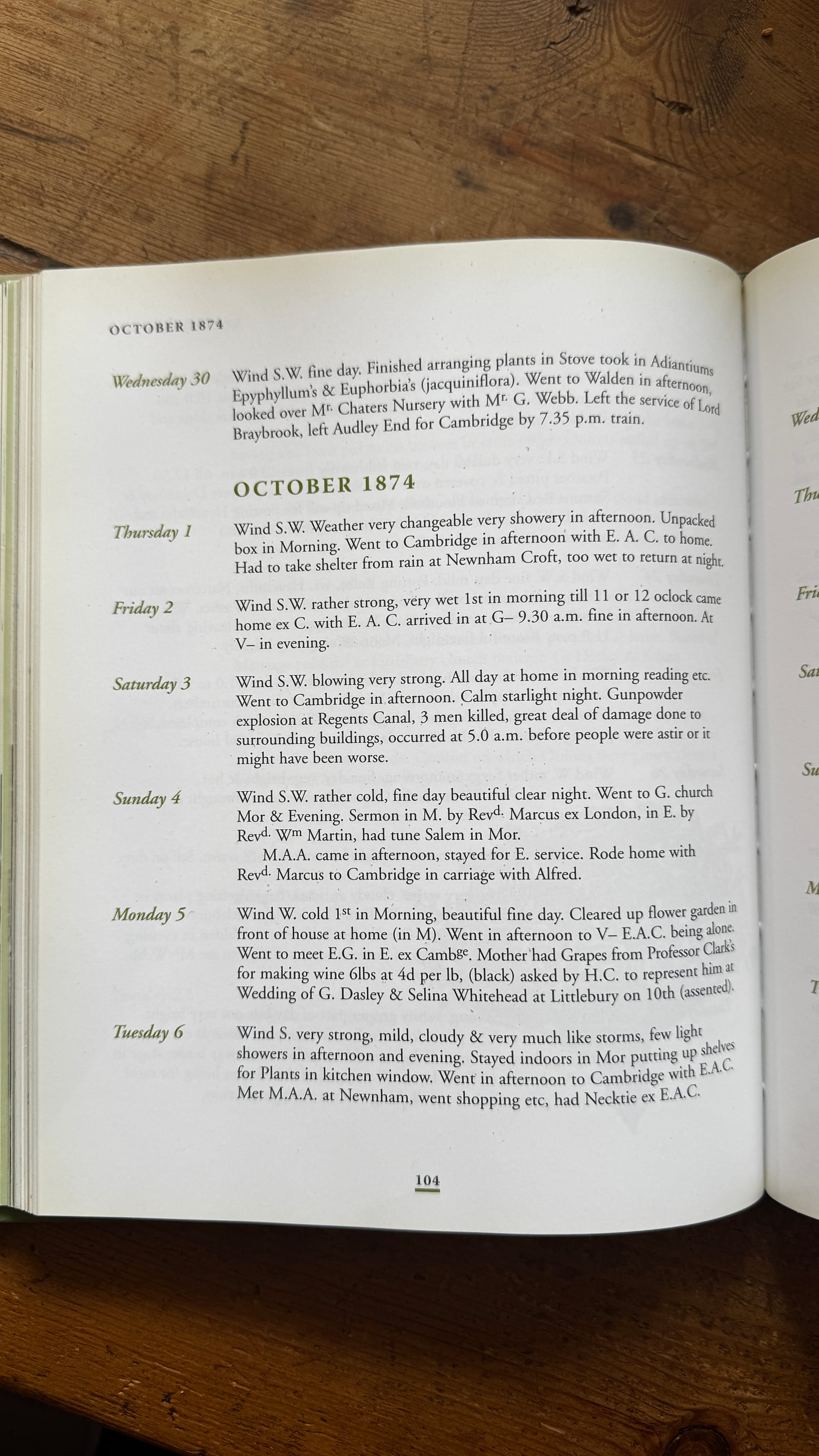
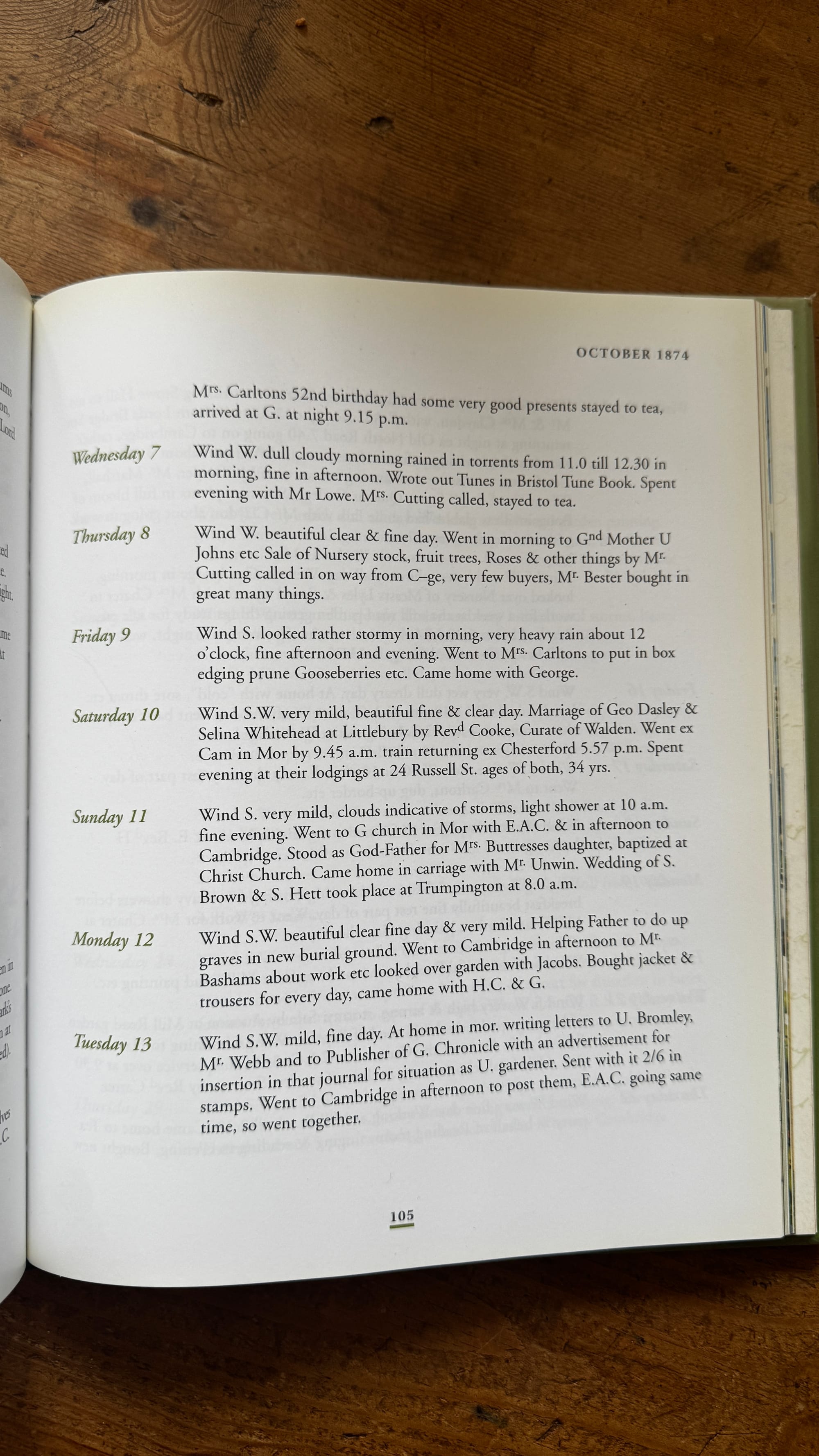
I tried to write like William: brief, terse sentences about the weather and records of sowing and planting out, with just little hints of personality. But I couldn't. So I wrote about hedgerows and new arrivals in the flower field. I wrote about planting bulbs and the mist in the valley and making crumble with the last of the apples. I shared what it was like to cut dahlias by the armful and the importance of hedges and edges and bones and structure in creating a garden.
Knowing that I was going to write made me notice. Sometimes I took pictures, but mostly I looked. I observed and I considered. My appreciation deepened through the act of capturing the essence of a moment in time, every single day, throughout the year.
The journal gathered momentum over the years, and with it a considerable, devoted readership. One of the first things that most people would say to me about their pleasure at receiving it every Sunday night was that I wasn't afraid to talk about the things that went wrong. And I wasn't, although I always had one limit: if something I'd written were read out to me in court by a judge, would I be okay with it?
At first this filtering was a wonderful thing. I do maintain that words are the point, and that putting my thoughts into words on a page gave me space and time to examine and process them, to capture the beauty of the falling light or the pleasure of a seed that germinated. The act of writing and the act of sharing multiplied my happiness and gave structure and meaning to my relationship with my garden and my world. I remember a foreshadowing, though, when my husband said, as we watched deer running across the field, "I wonder if that'll make the newsletter."
I heard those words many times over the years, sometimes from him but often from myself. Experiences and moments in the gardening year almost automatically became 'content'. I would see the moon and remember to make a note on my phone about including it in the Sunday journal. I'd go out to the garden first thing, and droplets of dew on a spider's web would be noted more than noticed.
A few weeks ago, all of a sudden and without really reflecting on the gap it would leave in my life, I stopped writing the newsletter. The primary reason was that the editorship of the Garden Collective is a huge honour and I want to do it justice, but the newsletter's absence has felt like a lifted weight, for reasons I didn't entirely anticipate.
NB: If you are going to set up a weekly newsletter, I would strongly advise not setting your publication time for 8 pm on a Sunday. However much I intended to write it in advance and use fancy scheduling technology, I never did. Every single newsletter was finished at my kitchen table at about 7.50 pm. It hung over my weekend. You will note that, as editor of the Garden Collective, I made the decision that our weekly newsletter would be on a Saturday morning.
I knew that giving it up would give me my weekends back and change how I gardened, but I didn't realise how much. Every virtue carried to the extreme becomes a vice, and the thing that had been a way of connecting to the seasonal shifts and changes had, over the years, started to become the opposite. I was consuming my own experience, mining it for content, moments and memories. It became something to share with others rather than to be experienced by myself.
I remember being taught mindfulness in my early days as a psychologist and the teacher saying, "You'll know you've cracked it when you stand at your kitchen window washing up and you're just washing up. Not mindfully washing up, not doing mindfulness whilst washing up, but just… washing up."
Last week I saw the moon and noticed that I didn't have to think about how I would put that into words. It was just me, looking at the moon and thinking how beautiful it was.
This change of heart is, of course, only about a specific sort of writing. I believe it's called 'reflective non-fiction'. Actually, I haven't even stopped doing that. It's my series, Garden Therapy.
It turns out I can't help making sense of my experience in words and sharing them. Even if my nephew, tortured by extra English tutoring, disagrees. This is a hill upon which I will die.
But me and my garden? That's just between me and her.