Plants Through Which I would Not Like To Run Naked
Naturism is generally a good thing but not if you encounter any of these plants.


Garden magazines and books are always eager to give us lists.
Best plants for dry shade. Favourite trees for a small garden. Champion houseplants. You will know what I mean so, not wishing to be left out, I have assembled a list of “Plants Through Which I Would Not Like to Run Naked”.
I have excluded cacti as they seemed a bit too obvious.
I don’t want you getting the wrong idea here - public nudity is not really my bag: especially now the tautness of youth has long retreated. I have been on a naturist beach twice: once in the South of France where the people were suntanned the colour of Nutella, keen on active sports and of a certain age. I was not sure where to look so made my excuses.
The other time was in Brighton. Many years ago, when such things were acceptable, I needed some pebbles for a client’s garden so the dog and I took the Land Rover to Brighton and shovelled some off the beach. I know this is not good form and I apologise unreservedly to both the municipality and good folk of Brighton. However, the point of the story is that while I was vigorously shovelling, various naked men walked past and I realised that my choice of beach could, perhaps, have been better chosen.
1. Prunus spinosa - Blackthorn

This is a hedging plant and can be mixed in with hawthorns to make a good thick barrier. It qualifies for this list because it has very serious thorns - so serious that they should probably carry a health warning.
They are quite long, very sharp and have an unpleasant tendency to go septic if they pierce the skin. This may result in such exciting conditions as mechanical dermatitis, foreign body synovitis, granuloma and chronic inflammatory infiltrates. I have no idea what most of that means but none of them sound at all fun. Don’t be a statistic, wear serious gauntlets (or full armour).
Apart from this marked unfriendliness it is a handsome plant (although, unlike the hawthorn, not good enough to make a garden tree) and is one of the earliest to flower. You will recognise it from the cloud of tiny white flowers - particularly effective on roadside embankments - which are mostly pollinated by bumblebees.
In autumn it sets fruit called Sloes which many of you may have heard of as these make one of the constituent parts of Sloe Gin. The raw berries are to be avoided as they are so astringent that they seem to suck all the moisture out of your mouth and leave you grimacing like a post operative Mickey Rourke. However, if you ask my friend Mark Diacono he will happily bore on for hours about adding fruit to alcohol. He is the GOAT when it comes to making liqueurs that sit unused for years in the back of the cupboard.
2. Ulex europaeus - Gorse

A plant with which you are most likely to come into full body contact as it grows happily in the hills above beaches. Be wary if setting off for any dune based frolicking in fading light: you do not want to settle down anywhere near a gorse bush. I also remember it growing all over the sandy heaths of Surrey when I was a child - sadly most of that heathland has probably now been turned into golf courses or ranch style mansions for Sir Cliff Richard.
It is a plant that is built for defence with every possible surface armed with pretty unforgiving spikes. It has a yellow flower which appears intermittently twixt Spring and Autumn. It is not a warm yellow, nor a soft yellow , nor a buttery yellow but the sort of yellow that spits out of the corner of its mouth and raises an interrogatory eyebrow. However, in spite of this hard boiled attitude the flowers have a light coconutty scent and are much beloved by pollinating insects. There is a company in Cornwall called Chocolarder than make divine gorse flavoured chocolate for which someone is selflessly sacrificing their fingertips in order to harvest the flowers. Apparently it is best to pluck from the sunny side for the best flavour.
3. Pyracantha (Firethorn)
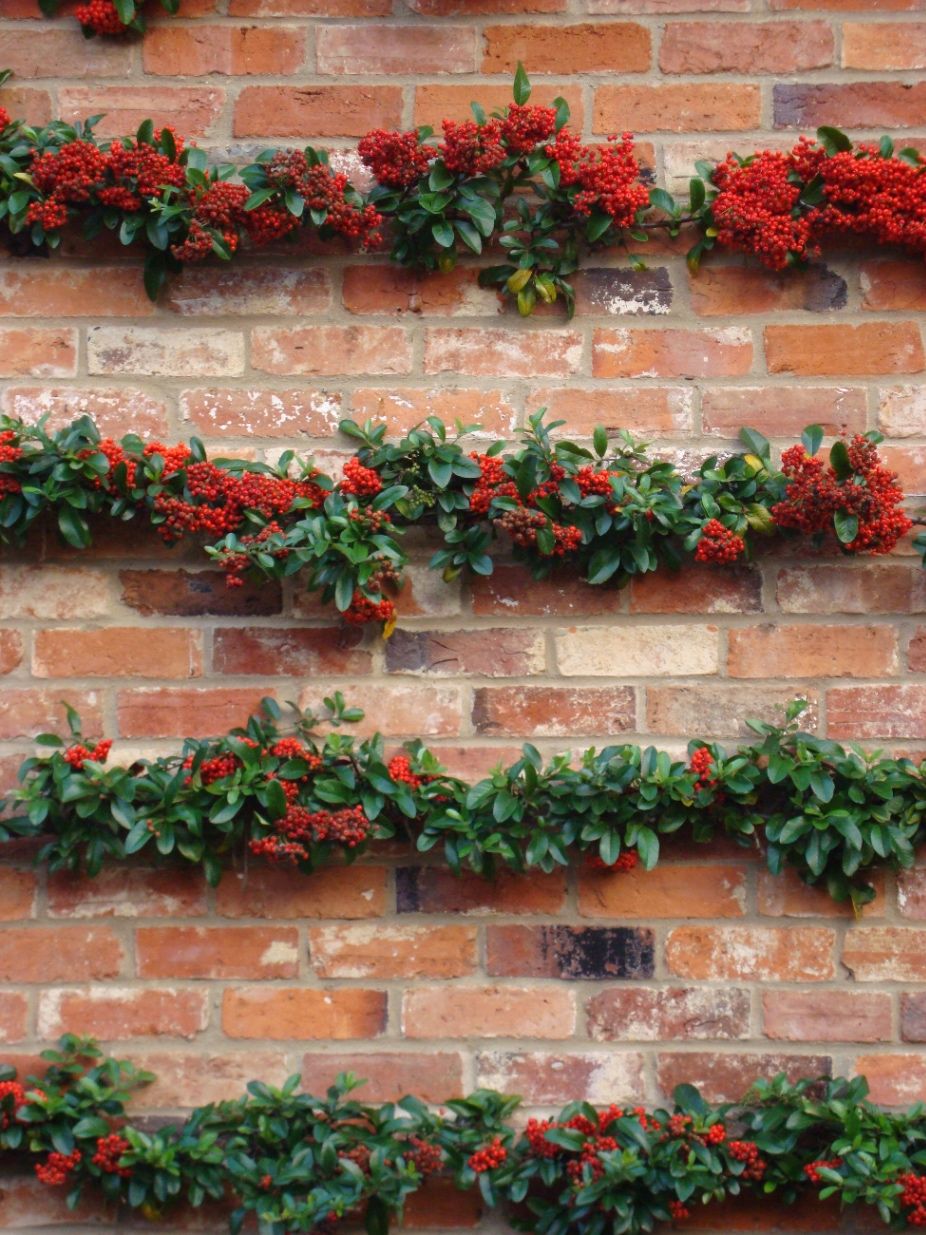
Often recommended by local constabularies to deter intruders. The spines are plentiful and any burglar would not enjoy the experience.
Thieves aside, it is a great plant with white flowers and berries in the autumn. The berries can be either yellow, orange or red (depending on variety), they remain on the branches until the new year when the blackbirds descend and make short work of them.
When allowed to grow unfettered it becomes a big messy bush about 3m wide and bristling with prickles - hence its excellence in the world of home security. However, it is very amenable to discipline and, with minimal effort, It can easily be espaliered or fan trained to a flat surface. All you need to do is cut off any branches growing in the wrong direction. I saw it being pruned this way years ago somewhere in Northamptonshire and shamelessly stole the idea for the north wall at both my previous and current gardens
Not so good at deterring criminals but very handsome.
4: Brambles

Really very clever chaps. They know how to survive, defend and reproduce themselves - they are a hedgerow Bear Grylls. The defence is easy to understand: nobody who has gone into battle with a bramble patch has ever emerged unscathed. No matter how much protective clothing you may don, no matter how thick your gloves or well buttoned your coat, it will always find a weak spot and stab you. I have had one that has removed my hat and then scraped its thorns across my scalp which seemed at the time to be unnecessarily vindictive.
The survival instinct is also pretty self evident. Those thorns are not just there to fend off the unwary gardener and to discourage fossicking animals but they also act as grappling hooks that haul the bramble through surrounding trees and shrubs - it is like watching a shipload of pirates creeping up on a heavily defended fortress.
As for reproduction, that is easy - not only does it put out roots every time the branches hit the ground but the berries taste good therefore every bird, badger, mouse and fox in the hood will come and eat them. As they go on their merry way nature’s cycle will mean that the seeds are successfully deposited (along with a nutritious dollop of fertiliser) all over the place. In addition the thickets provide shelter and protection for nesting birds while the blossom attracts bees and butterflies in droves,
You should never pick blackberries after Michaelmas (the end of September) as that is when the devil pees all over them. Basically, when he was kicked out of heaven he fell down to hell where he landed in a bramble bush - so upset was he by this final indignity that he cursed the blackberry and urinated all over them. Quite understandable, I suppose: he had had a pretty rough day.
Not the most pleasant of images but if you have ever tasted an October blackberry you will understand the origins of the story!
5. Roses

Roses have always had great PR. Year after year they are voted Britain’s most popular flower. They hold all the cards: romantic, scented, soft petalled things appearing in bridal bouquets, Valentine’s Day courting, apologies, mad gestures, anniversaries and, indeed, funerals.
All that sentiment successfully smothers the fact that, like spurned lovers, they are deep down vicious. They have stiffly hooked thorns that will easily dig out a sizeable chunk of flesh unless you are careful. Some thorns are exceptionally beautiful- in particular the berry red shark fin thorns of Rosa sericea Pteracantha. Some (like the rugosa roses) have stems clustered with thorns, climbers are particularly dangerous as the stems wave around like disgruntled octopi.
My parents once had an old R. Kiftsgate in an apple tree which I volunteered to prune. For those who do not know this particular variety it is a rambler which is perfectly capable of engulfing the average terraced house. I reckon that if the bad fairy who imprisoned Sleeping Beauty for a hundred years had a good sense of aesthetics she would have planted that rose around the castle - if less bothered by such things she would probably have settled for bog standard brambles. Those two days pruning resulted in a mass of lacerations. Never before or since have I laid down so much of my tender flesh in the name of filial duty.
I am sure there are others which I have left off the list - I have not even started on things like the Ceiba species which grows in South American forests and whose trunk is covered in spikes or the Australian Gympie-Gympie tree famous for its excruciatingly painful sting. Feel free to add your own choices.
At the Garden Collective we smile benignly at harmless nudity but, you have been warned...