Rook around the clock tonight
The mischievous charm and antics of rooks: where birdwatching meets folklore and sticks are very important


I have an old friend called Frank - well, actually he was christened Alexander but soon became Frank as he shared his surname with one of the great footballers of the 1970s. In our youth, we used to tear around the lanes of Dorset at at least 28 mph on our mopeds. Sheep would saunter casually out of our way and the elderly would look at us tuttingly. I was not really cut out to be a biker but he went on to become a motorcycle messenger in London in the pre-email days when, if you wanted to send something and you could not wait for the post you summoned a biker who roared across London with your letter in his panniers.
In the eighties he drove a double decker bus to the south of Portugal and never came back. Not because of any tragedy but because he changed his focus from bikes to birds. Not in a 1970s woooerrr, nudge, nudge way but because he became obsessed by ornithology.
This is a long winded way to get to the subject about which I wish to bend your ear which concerns the birds in this garden. In this case not the usual lot for whom we go to all sorts of efforts - providing accommodation, fat balls and nuts - but the less cutesy, but far more intelligent corvid family, in particular, Rooks.
Not as obviously charming as the tits and chiff-chaffs but big characters with beaks like the noses of fairytale witches.

"Alright, Steve?"
I have lived within chucking distance of a rookery for at least three decades now and find the croaky cawing a comfort. At our last house we were surrounded by woods which were home to hundreds of rooks, here the rookery spreads across a scattering of tall ash trees in the fields around the garden. They build their nests high up in the branches where, somehow or other, these precarious structures survive the clattering and swaying of the branches in the wind.
At this time of year they are in full on nesting mood. Typically rooks mate for life and tend to occupy the same nests to which they keep adding sticks. Right now they can be seen wandering around the garden and the village green picking up bits of stick to build their nests. Stick collecting involves a lot of chat
“Hey: look at this one. Isn’t that a great stick?”
“Wow. Nice one Steve (I like to think that lots of rooks are called Steve: it suits them). I'll swap it for this one.”
“Na, this one's mine. Tell you what - you have that one. That would look great in your front room.”
“Cheers. See you Steve”.
They eat worms mostly and for much of the year they float about in huge flocks digging around in fields - farmers are not always keen on this, especially as the birds are far too clever to be distracted by such antediluvian technology as scarecrows or people shouting.
Rooks just wanna have fun
Rooks look as if they are having fun: they are party people. Rooks are a group of clubbers in Newcastle strutting along in short skirts and T-shirts as the temperatures plummet, a flock of seven year olds high on sugar charging around a soft play centre or a gang of young farmers at the Cheltenham Gold Cup. More than one visitor to this house has been woken at sunrise by the din of busy rooks: not for them the slugabed habits of humans, they are up early, always busy and perennially chatty.
They have a more serious side as well. From medieval times a gathering of rooks has been called a Parliament (Geoffrey Chaucer wrote a poem on the subject). It comes from the myth that the birds would hold a solemn meeting to decide the fate of any rook found to have stolen twigs from neighbouring nests rather than gathering their own. Rooks consider this sort of behaviour unbecoming and morally corrupt. So unspeakable that, apparently, it might result in the death by execution of the misguided defendant in order to preserve the good standing of the community. I am not convinced about this one...

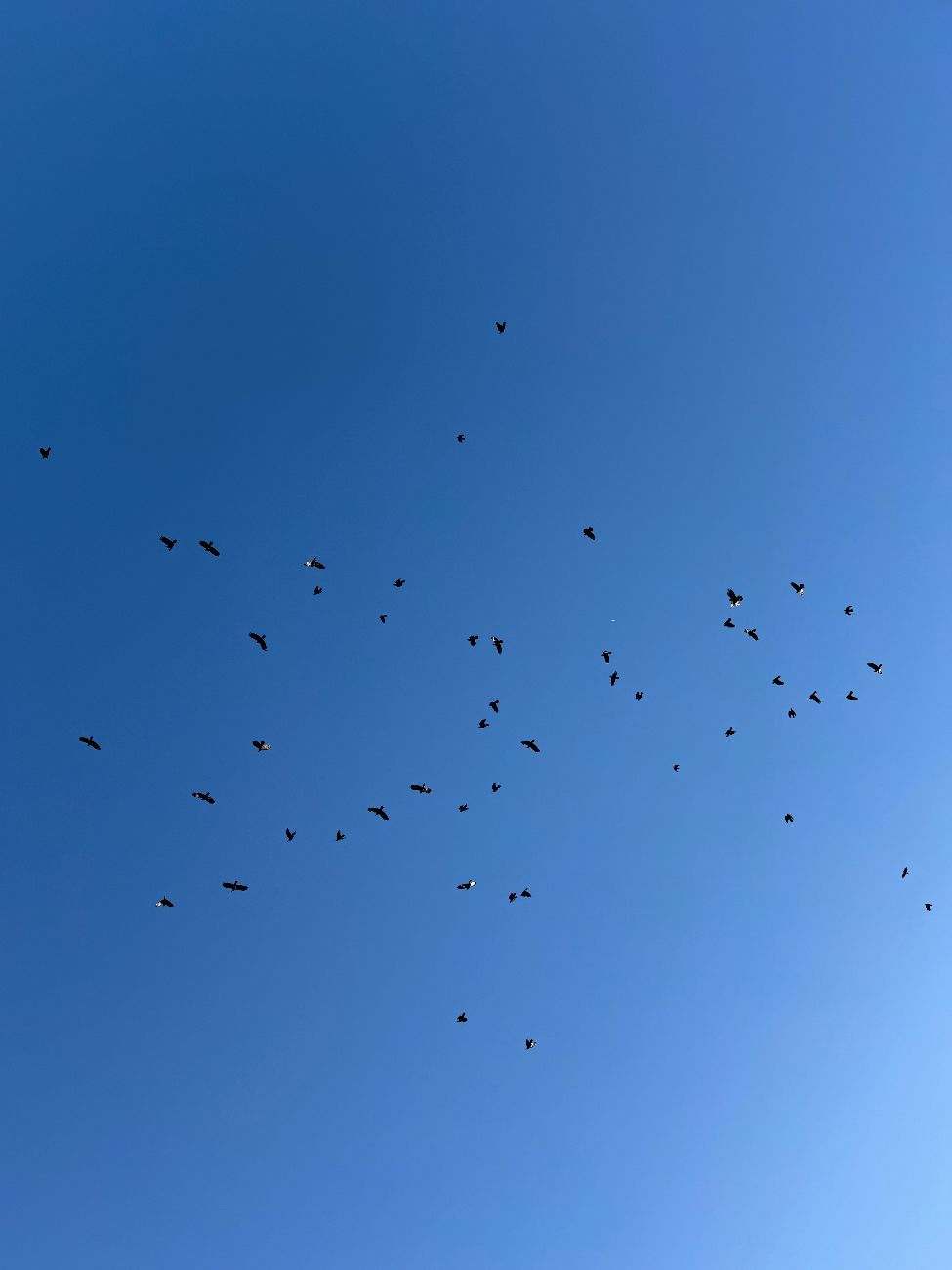
There is often confusion when identifying rooks when they are just black dots in the distance. Are they rooks? or crows? You will be pleased to know that greater minds than ours have been befuzzled by this question. Tennyson, for one, with his ‘many-wintered crow leading the clanging rookery home’. In Norfolk the explanation is simple: ""If thass crows, thass rooks; and if thass a rook, thass a crow". For the benefit of our international readers and to avoid too much confusion I also refer you to the explanation given to me by Frank - a rook on its own is a crow. A crow in a crowd is a rook. Simple.
Never, tho' my mortal summers to such length of years should come As the many-winter'd crow that leads the clanging rookery home. - Alfred Lord Tennyson
Unsurprisingly rooks feature quite a lot in rural folklore. For example they can predict the weather - high nests mean a cracking summer, low nests mean it will be a bit grim and if they feed in the street a storm is brewing. Some stories have rooks as portents of doom and imminent death, others put a more cheerful twist to it. For example, rooks deserting the roost was said to foretell the downfall of the family in whose trees they lived and if they moved into a town or village then the population had better watch out. Conversely, it was said that rooks would only build a rookery near a house where the people were of a kind and generous disposition so the presence of such a magnificent collection of birds here makes me feel sure that we must be doing something right.
Aerobatics
Every evening they put on a show. As the sun sets the clamours of rooks, feathers as black and sleek as oil slicks, turn and wheel and caw as they settle into their teetering tree top nests. The noise settles into a light chatter and you think that is it but no, a minute later, a group lifts off again and we are treated to another display of noisy acrobatics.
They are like children reluctant to go to bed and it is pleasure to share the garden with them.