Seeds of Change: Harnessing Lunar Power in Your Garden
New research suggests there really may be a link between the moon's phases and the way plants grow. Is it time to make use of this ancient knowledge for ourselves?


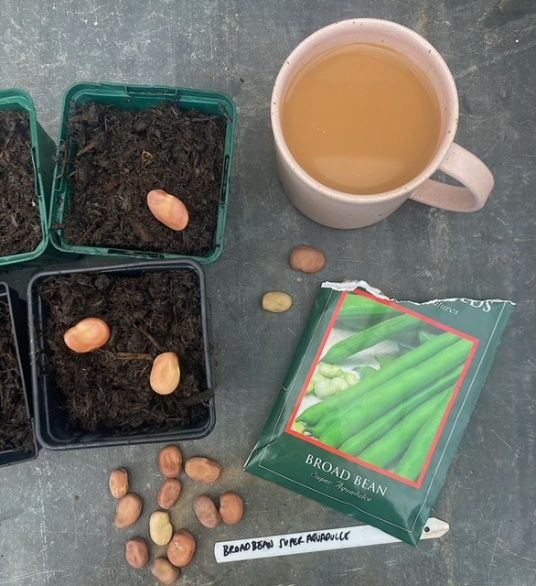
It is late autumn and I am in the greenhouse with the rain pattering down on the glass, stained-glassing a smattering of fallen yellow leaves flat to the roof panes. I have a cup of coffee steaming away on the bench, Irving Welsh talking wryly on the radio, and I am pushing broad bean seeds into chilled compost. I am also harnessing the power of the moon.
Call me a hippy – you would not be the first – but I have long been fascinated by the idea of gardening with the moon. My cynic and Pollyanna selves are at war here: on the one hand any googling around the idea that we should carry out particular tasks during particular moon phases will repeatedly smack you down: there is nothing to it, it is a load of nonsense, it is confirmation bias and wishful thinking.
And on the other…well, like Fox Mulder I want to believe. I want to believe in ancestral knowledge and traditional beliefs handed down over generations, in the magic of the tides, and in the idea of our gardens dancing to a beat that we don’t quite sense.
A helping hand
I also often feel as if I’m battling some unknown force when I’m gardening – everything goes wrong, the thing damps off, gets nibbled by mice or slugs or simply doesn’t even deign to germinate. I’m swimming upstream and I don’t understand why. And then at other times everything just slips into place. Energies align, sparkplugs fire, the thing germinates, grows, thrives, laughs in the face of moulds and molluscs. What made the difference? And could it possibly be the moon…?
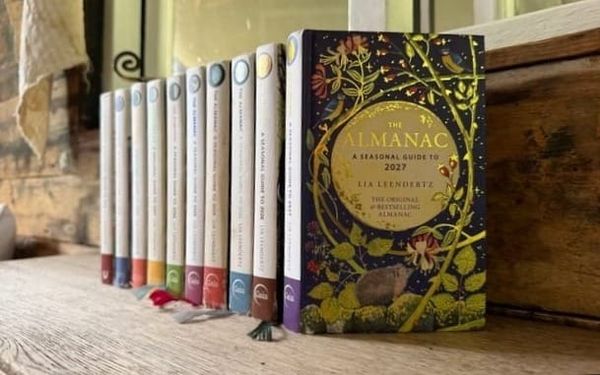
Before we go any further I have to admit that I have some skin in this game: I produce an annual almanac which contains – among lots of other information - guidance for gardening by the moon, according to traditional practices. But I have always done this at a bit of a haughty distance: the information is there, help yourselves. I do not vouch nor naysay. Make of it what you will. I take no responsibility.
Old wisdom meets new science
But now something has compelled me to jump off my self-constructed fence, and that something is evidence. While it is relatively easy to find people who grow according to moon phases and have results to prove it works, there are very few who will attempt to tell you how and why that is so. Ernst Rudolph Zurcher in his study ‘Lunar Rhythms in Forestry Traditions’ looked at old moon wisdom around wood harvest timing, namely that wood for construction and furniture making - anything that needs to be durable, rotproof or fireproof – is harvested during a waning moon, and firewood during a waxing moon.
The study also took in scientific experiments measuring trunk diameter, fire resistance and resistance to termites in wood harvested during the waxing and waning phases.
And it appears there really is a pattern of changes on the cellular level depending on moon phase, and that those changes make a difference to the durability of harvested wood. He can’t explain why, and states that due to the extremely weak gravitational forces involved these differences are unlikely to be down to the direct gravitational effect of the moon.
Tree tides
Zurcher posits that the earth-atmospheric electric field, known to vary in conjunction with lunar phases, may be playing a role in the phenomenon, but does not know how. He suggests that there are lunar rhythmic variations in the wood-water relationship, or the fixing of water in the cell wall, that affect durability, strength and fire resistance.
Although the mechanism is unclear, his results back up centuries of traditional knowledge about wood harvesting. It is easy to make the leap then and think: if this traditional lunar knowledge has a scientific basis, perhaps the rest does too. It certainly feels like enough to convince me, so it’s time for me to take the ancestors a little more seriously, and throw my lot in with them.
A monthly date with the moon
And so my plan here is to start gardening by the phases of the moon and also to also call in whatever traditional sayings and garden lore fit the month and play around with those out too. I will write about it here and I give you all the relevant dates, sayings or phases for the month ahead so that – if I have convinced you – you can join in, and I hope you will let me know how you get along.
There will be no control sowings or weighing of crops on my part – though you are welcome to do this if you wish. I simply don’t have the space, or indeed the brain. But hopefully between us we will see if our gardening becomes lunar-charged…or if it just moseys along much like before.
Lunar-powered broad beans
Which brings me back to the greenhouse, the rain, and the radio. Earlier today I realised I was running out of ‘waxing moon’ and dashed to the garden centre for some broad bean ‘Super Aquadulce’ seeds. Waxing is the time when the lit part of the moon is growing from new and dark through crescent, then half, then up to full moon, and it is traditionally associated with upwards growth: the best time to sow those plants that will bear their crops above ground, such as broad beans.
My hope is that whatever the mechanism caused all those many generations of farmers to think this important kicks in now, as the seed swells, proteins are hydrolysed, amino acids fire up, and the whole business of producing next spring’s broad beans begins, with the moon in full supporting role.
I will of course be reporting back as the seasons move on. We’ll be looking at other garden folklore each month too, and trying all sorts of things out along the way, so let me know of any gardening lore you have rattling around in the back of your mind that we could all give a whirl. I'd love to know if you’ve ever been intrigued to plant with the moon, or if you might be tempted to grow along with me now. Do join me – and those ancestors – for the ride.
Moon gardening dates for November
(for a more detailed version see my book, The Almanac, a Seasonal Guide)
New moon to first quarter: 1st November (from 12.47) - 8th November and First quarter to full moon: 9th- 15th November
The waxing of the moon is associated with rising vitality and upward growth, particularly the times closer to the full moon. Sow crops that develop above ground – now that would be broad beans, hardy peas, sweet peas - but avoid root crops. Take cuttings and make grafts.
Full moon to last quarter: 16th - 22nd November
A ‘drawing down’ energy. This phase is a good time for sowing and planting any crops that develop below ground: root crops, bulbs and perennials. Right now that would be tulips, ornamental alliums, garlic cloves and overwintering onion sets in the garden, and paperwhites, miniature irises and forced hyacinth bulbs for late winter indoor flowers. Plant anything that needs to develop a good root system: rhubarb crowns and bare root fruit bushes, new grape vines, peaches, nectarines, apples, pears, quince and medlar, flowering perennials. Lift, divide and replant flowering perennials that have finished flowering now.
Last quarter to new moon: 23rd - 30th November
This is considered a dormant phase, with low sap and poor growth, and so not a time to sow or plant. It is however the perfect phase for pruning, while sap is slowed, so a good moment to prune your apple, pear, medlar and quince trees, rose bushes, fruit bushes and grape vines (which – traditionally, again - should also be pruned before the winter solstice on 21st December). Good time for weeding, harvesting crops for storage, garden maintenance, and fertilising and mulching the soil.