The Art and Craft of Gardening
If you want your garden to look better next year, then put down your spade and pick up some knitting needles.


Do you have fun in your garden? I am going to assume that you enjoy gardening, because why else would you have a subscription to The Garden Collective, but do you actually have fun? How much of your time is spent in a state of mild anxiety and how much in entertaining experiment and exploration?

I believe that gardening is the ultimate act of creation, but I know far too many people who treat it as a technical exercise underpinned by endless lists of things that must be done. In my experience, the most inspiring gardeners work, if you like, from a sketchbook, not a textbook. Their gardens are not just curated collections but living canvases full of potential.

There have, of course, been plenty of literal artist gardeners. Gertrude Jekyll had ambitions to be a painter until failing eyesight channelled her creativity sideways into garden design (although she also dabbled in carving, embroidery, gilding, metalwork and photography). Sir Cedric Morris not only established the East Anglian School of Painting and Drawing at Benton End in Suffolk (where his pupils included Lucian Freud and Maggi Hambling) but he also created a garden of equal renown, which was eventually acquired by the Garden Museum and is currently being sensitively restored by the talented, artistic (and ridiculously nice) head gardener James Horner. And there is the extraordinary, semi-surrealist garden created by artist and filmmaker Derek Jarman at Prospect Cottage, on the bleak expanse of shingle beach at Dungeness.
The art of gardening
All the most engaging gardens I know have been created by creatives active in other fields as well. At my all-time favourite, Great Dixter in East Sussex, Christopher Lloyd would fill his winter hours with needlepoint and cookery, developed a discerning collection of the works of studio potter Alan Caiger-Smith, commissioned furniture from contemporary craftsman Rupert Williamson and loved to listen to the music of Brahms, Beethoven and Bach.
As Lloyd himself wrote, the best gardens bear the imprint of their owner’s personality. It is what separates them from the outdoor housekeepers who stress and fuss as they wrangle their plants into submission. I have one of the latter breed living next door to me, and right about now she will be coming to the end of an exhaustive six-week mission to eradicate all evidence of autumn by continually ‘vacuuming’ her front garden with a leaf blower. I dare say she gets a sense of quiet satisfaction as she surveys her garden for the five minutes it is leaf-free before the wind blows again, but I don’t think she experiences the sort of deep joy that comes from working with nature to realise a vision that you have conjured in your mind’s eye.

I was talking to an old friend in the RHS advisory department the other day. He had just run some clever algorithmic analysis of the questions they got asked and, even after 20 years on the job, he was surprised to realise just how many of those questions were framed in terms of anxiety, guilt and failure. In other words – people almost always asked what they had done wrong, not what had gone wrong.
We all know the ‘rules’ of creating a garden. Some of these are practical – orientation, soil type, light levels, prevailing climate. And obviously these are important. There are also lots of general guidelines about spires and mounds, foliage shapes, flower colour and succession of interest. And again, these can be useful. Follow them rigorously and your garden should look good, but it is unlikely to look great without a bit of flair. Originality is the secret sauce that makes the whole thing sing.
The creative mindset is something that so many of us have lost in our increasingly virtual world, but it is something that you get better at the more you do it. Which is why, with the longer nights and shorter days of winter currently confining us to barracks, I would like to suggest that the best thing you can do for your garden over these quieter months is to devote some time to honing your creative skills.

When was the last time you made something with your hands? I tend to go in fits and starts, with a few half-finished projects sitting reproachfully in a drawer, but over the years I have treated myself to some lovely workshops where I wove a basket, made my own willow obelisk, and slowly carved a chunk of soapstone into something that insisted on being a conch shell however often I tried to turn it into an abstract homage to Barbara Hepworth. But for you it might be making a pot (which is next on my bucket list), mastering watercolours, or maybe just mending a sweater.
All crafts teach patience and attention to detail. You have to slow down, observe and appreciate small changes – the very same skills that you need in the garden, whether you are pricking out tiny seedlings, judging how best to prune a shrub, or intervening just in time to stop a stressed plant becoming a dead plant.

Both crafting and gardening deepen your connection to the process and take focus away from the end result. And a crafter’s eye for colour, texture and form translates beautifully into garden design.
Sarah Price is a landscape designer whose work is regularly described as painterly, awash with layers of colour and exquisitely atmospheric textures. In her own garden in Abergavenny she plays with planting effects in the same way that she has experimented with paints since her days as a Fine Art student.
Her dreamy garden at the 2023 RHS Chelsea Flower Show, inspired by the paintings of Cedric Morris, and filled with his own selections of dusky Benton irises combined with aeoniums and Elaeagnus ‘Quicksilver’, almost broke the internet. It was an exquisite mix of considered horticulture, visual art and material craft and it was absolutely wonderful. Granted, it was a show garden, where a lot of the normal gardening rules do not apply, but Sarah went on to create a real-world iteration at a community centre in the south easterly extremes of London which proved that elevated artistry can exist even in a gritty public space where the Number 99 bus trundles past at regular intervals.
I don’t know how many other people could have realised that vision quite so exquisitely, but I do believe that all of us have the potential to make beautiful things. Creativity is not a gift but a muscle that can atrophy from disuse. Ask any toddler to paint you a picture and they will grab their pens and set to work with concentration and delight. Ask an adult the same thing, and most will politely inform you that they really are hopeless at art and wouldn’t dream of inflicting their efforts on you.

So in the 30-odd years that separate one mindset from the other, what happened? For most of us, the answer is simply Life, and the habits and pressures that come with it. When you are busy you need to be efficient and that leaves little bandwidth in which to play. When you are used to completing your daily tasks with a degree of competency, it can be alarming to try something new that might not work out quite as well as you hoped. And the less you work with your hands, the less likely you are to believe that you possess the manual dexterity to try and make something worthwhile.
But your creativity, like your biceps, can be strengthened with practice and attention. Which is why the best thing you can do for your garden this winter is to take up a new craft, or rediscover an old one.
So why not start now? Go out into the garden. Pick up a leaf or a seedhead that catches your eye, then bring it back inside and sketch it. Maybe the result will be awful, in which case remind yourself that your toddler’s stick-figure family portraits were usually pretty short on photorealism. Maybe you will surprise yourself, either because the finished picture does actually look a little bit like the leaf or seedhead sitting on your kitchen table, or because you enjoyed the process, or both. It doesn’t actually matter much either way. The point of the exercise is not to make something perfect, but to make anything at all.
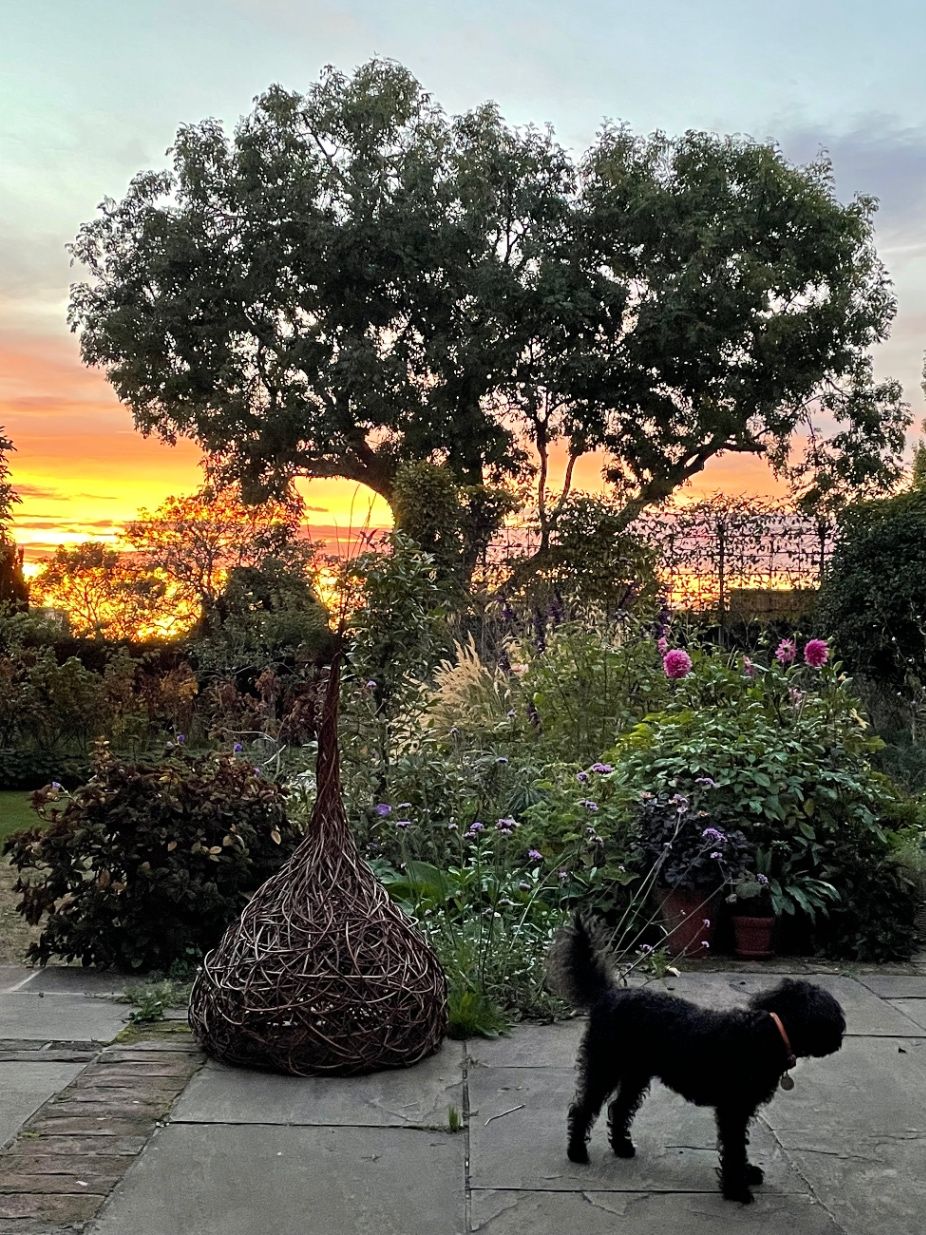
As Cedric Morris said, we may all have the same palette but we are all creating a different picture. Reawaken your creative core and you will emerge next spring as a better and happier gardener.