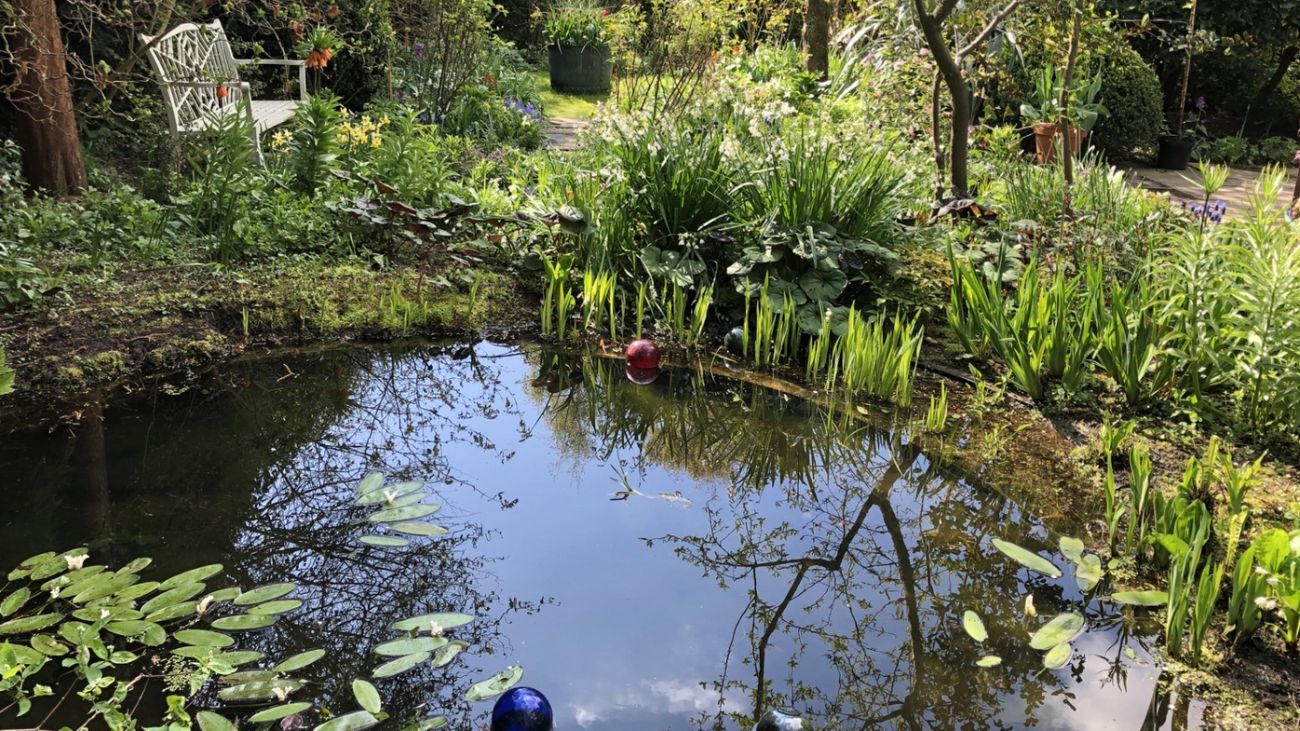
Why Are People Still Enthralled by English Gardens?
Although our love affair with American prairie plants shows no sign of abating thanks to European designers like Piet Oudolf, the rest of the world wants to be British.


I'm Kendra and on this platform, I'm going to talk about the way people think they think, but often aren't thinking at all, about their outdoor space.
Last year, I spent six months travelling around North America with a photographer, talking to people for a book on private gardens that exist for ecology. The designed landscapes were energising and extremely photogenic, but away from these places, I was struck by how big the 'English look' still is, 250 years after the American Revolution. Not only in New England but everywhere. And it's not just the lawns, which make no sense in most of the States (unless they're planted with regionally native, un-thirsty grass, which is rarely the case). Anglophile gardens, consisting of topiary and neat flower beds—and outsized lawns—were the baseline in every middle-class neighbourhood in California, Arizona or Texas. To me, they revealed a sense of unease with the actual world around them.

This was puzzling because American nature is stunningly beautiful. Sitting in the back of a car on the way from Los Angeles to Pasadena, my view across the ten-lane freeway was of mountain foothills. They were covered in a ravishing tapestry of indigenous plants, known as chaparral and coastal scrub. When there are a dozen native sages to choose from in Southern California, who needs a Piet Oudolf? These plants were self-arranged and self-sustaining. Closer to towns, thriving landscapes were replaced by awkward shrubs sliding down the hillside, underpinned by black fabric and sagging irrigation equipment. It was the same story on the high desert plains of Colorado and former prairie country in Illinois: native plants across the United States give you a lot to work with. There are incredible regional trees as well: groups of California live oak (Quercus agrifolia) or their southern equivalent, Quercus virginiana, are fabulously atmospheric, their low, dark branches adding mystery and grandeur to any middle-storey planting.
Is your garden outsourced?
It's not easy to maintain English gardens, whether of the cottage or manor variety, in a climate of extremes. All across the continent, the loud noise of clean-up crews, as they mow and blow, is a reminder of the difficulty of keeping the very real wilderness at bay, and replacing it with something 'normal'. Last July I stayed at a house on the Main Line in Pennsylvania (that string of affluent neighbourhoods made famous by The Philadelphia Story) where the din of professional maintenance is the outdoor soundtrack, for nine months of the year. When a truck pulled into the grand, circular driveway where I was staying, a ride-on mower was unloaded, followed by a stand-on vehicle that whizzed around, squirting the mowed grass. 'Do you have pets?' the man shouted as he approached. 'No, why?' I shouted back. 'Because you might want to keep them inside for half an hour,' he told me, spraying up to the edge of the porch where I was sitting. As he was leaving, I asked him what he was spraying. He said it was two things: fertiliser, to keep the imported, cool-season turfgrass alive in high temperatures, plus weed control – because everything else in the lawn becomes overactive in hot weather. It's how a lot of people think: gotta keep control.

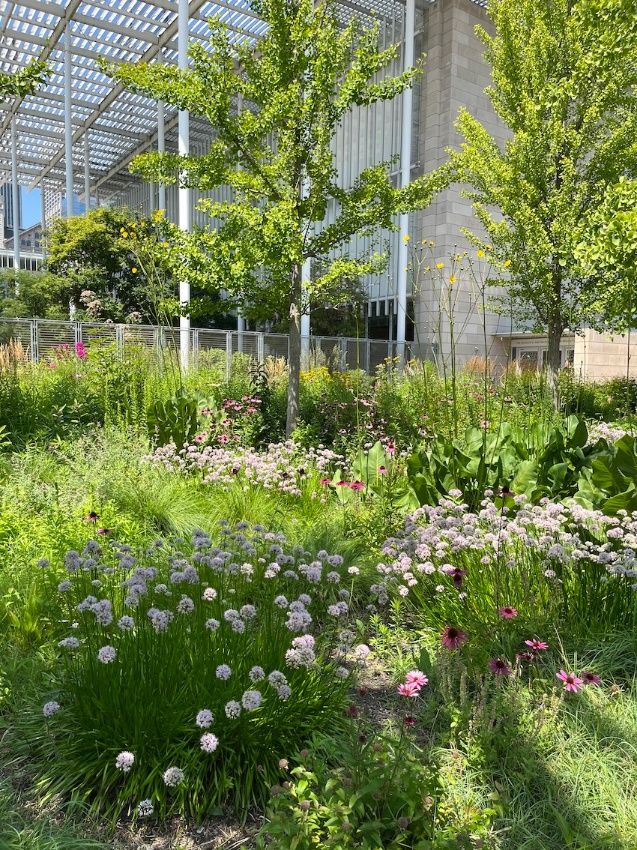
Fear of the wild has allowed the incredible abundance of American plant material to be undervalued at home. It's startlingly good when it IS used with imagination, by Americans, and it makes a really theatrical combination with buildings. Stoneleigh is an old mansion that's also on Philadelphia's Main Line; it's managed by conservation charity Natural Lands, and it's free to visit. The original bones of the garden are 19th-century American Beaux-Arts, a grander version of Arts and Crafts. But around every set piece (the pergola, the rockery), all the plants are native or native cultivars. They are much more interesting than imported 'ornamental' plants. Liquidambar is clipped into shaggy mounds; Magnolia grandiflora 'Teddy Bear' is grown as narrow cones, lined up into an idea of a hedge. Variegation is explored, brilliantly, with white and green eastern redbud, forming full stops in the mowed edges of what is otherwise long, native grass. Yellow and green witch hazel (Hamamelis virginiana 'Lemon Lime') is espaliered under a bay window.

Even the most unpromising place can be a showcase for this kind of atmospheric planting. Take Phoenix airport's outdoor smoking area; it's a highly rationalised slice of the Sonoran desert, which looks incredibly good in the astounding heat; I lingered out there for as long as I could take the smoke fumes (and the rest).
England's dreaming
Back home, I am reminded that the UK is one of the most nature-depleted places on earth. It has been cultivated for millennia, but that's no excuse. I'd like to throw this out there: we on the British Isles like being a 'nation of gardeners' and it's true, there’s nothing like an English spring and early summer. But enlightened gardeners in other places (who aren't dreaming of English gardens) are tackling, with gusto, the real environmental issues that we also face. It's partly because for now they are at the sharper end of climate disruption, but I strongly suggest that it's time for us to start looking over our own shoulders—not in an insecure way, but to learn from others how to be good gardeners.